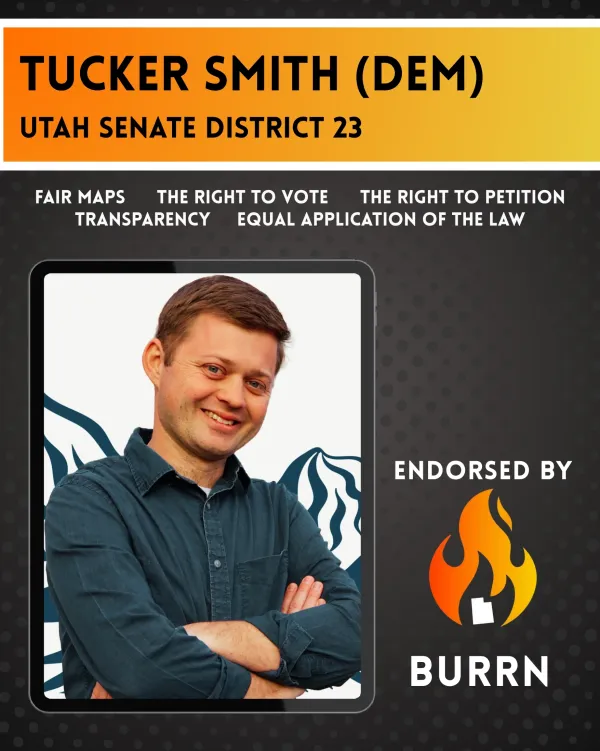
- Do you support or oppose the Independent Redistricting Commission and Standards Act that Utah voters approved in 2018? Please explain your reasoning.
- I support the Independent Redistricting Commission and Standards Act. Governments need to be accountable to the people they serve, and gerrymandering weakens that accountability. We need fair maps that accurately represent the people of Utah, not shore up the power of those that already have it.
- What should happen when the legislature disagrees with a map the commission produces, and what would you do in that situation?
- The commission's map should stand. It's as close to non-partisan as we can get, and it allows us to have confidence that it doesn't favor one party over another. As a state senator, I would respect the map the commission provided and fight for it to be adopted.
- Do you support Utah's vote-by-mail system as it stands?
- Yes, 100%. I have been so grateful for Utah's strong and safe vote-by-mail system. It has allowed me to vote when I can, not having to wait in a line or take work off. As a state senator, I will fight to preserve it.
- What would you do to encourage more people to vote who currently don't vote?
- We need to fight for a society where people have the presence of mind to genuinely participate in politics. Individuals and families today are utterly exhausted by the pace of the modern world: 40-60 hour workweeks, multiple jobs, deadlines, a flurry of family activities, combined with social media and a never-ending news cycle that creates panic and chaos at every corner. To even be heard in this crazy reality, political institutions and parties have had to resort to fear-mongering. This has caused such a toxic environment that it pushes out anyone not seriously invested in politics and leads to disillusionment with our political system. No one who isn't a politics buff wants to expend the emotional energy necessary to exist in the political sphere.
- What I would do, as a candidate and a state senator, to encourage more people to vote is to provide a message and a vision they can believe in, that motivates them to vote for something, not just against something else. What I would do is to fight against this kind of society, in favor of a society that allows people to live, to breathe, to feel. What I would do is work towards a political sphere that isn't so toxic, that doesn't take such an emotional toll on those who exist in it. What I would do is use the expansive prosperity and the advancing technology we are developing not to speed things up, but to slow things down. That, over time, will help many more of us readily accept the responsibility of a citizen--to think, to act, to vote.
- Utah voters can put questions on the ballot through citizen initiatives and referenda. Should the threshold for passing them be changed? Why or why not?
- Definitely not. Having a higher threshold to pass laws for an entire citizenry than the legislature needs is ridiculous. If a referendum passes, it is a sign that the will of the people is markedly different from the will of the legislature. Changing the threshold only punishes the people, when it should be the legislature that is held accountable.
- What do you see as the relationship between transparency and corruption?
- Transparency is the first step in dissolving corruption. We, the people of Utah, need to know what corruption exists in our government before we can ever hope to put an end to it. Expanding transparency is crucial to any attempts to eliminate corruption.
- Does Utah's GRAMA support the public's right to know, or does it need strengthening? Or is it too stringent?
- I'm in favor of strengthening it. I admit I don't know many of the details, but I am in favor of strengthening transparency in general. I certainly would not want to weaken GRAMA.
- Describe a specific action you would take in office to make sure every person in your district has equal access to government services and equal protection under the law, regardless of citizenship status.
- I would support a constitutional amendment that enshrines this equal protection, regardless of citizenship status, and makes it very difficult to eliminate. We saw it nearly happen with Trevor Lee's bill, and it can never get that close to happening again.
- Is there anything else you think is relevant that our questions did not reach?
- Thank you!