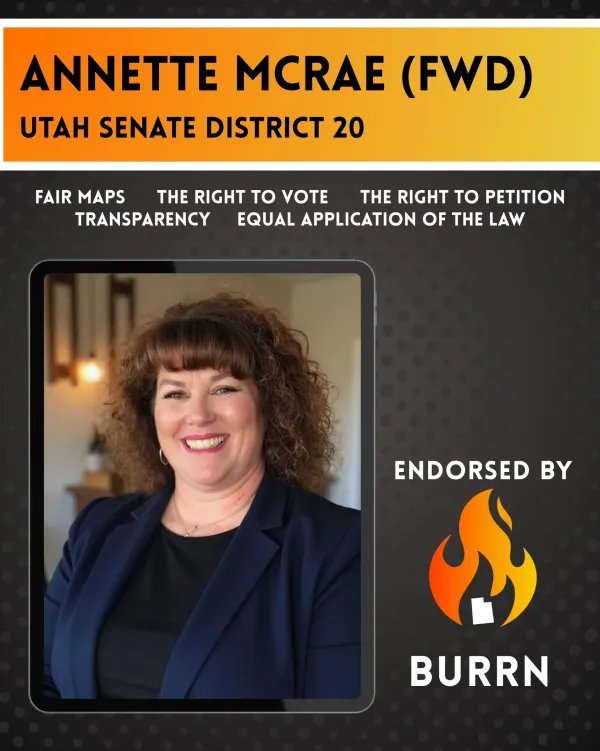
- Do you support or oppose the Independent Redistricting Commission and Standards Act that Utah voters approved in 2018? Please explain your reasoning.
- I support it. Voters deserve fair representation, and district boundaries should not be drawn to protect an incumbent or give a political party an unfair advantage. An independent commission, public participation, and clear standards provide necessary checks on that power. Communities should have a meaningful voice in how they are represented. I would apply those standards equally, even if a fair map did not benefit my own campaign or party.
- What should happen when the legislature disagrees with a map the commission produces, and what would you do in that situation?
- Disagreement should require a public explanation supported by evidence. Legislators should identify which fair-map standards they believe are not met and show how any proposed alternative better meets those same standards. The public should have time to examine the maps and respond before a vote.
- I would review the evidence, listen to affected communities, and oppose changes designed to protect incumbents or partisan control. Disliking the likely election results is not a legitimate reason to reject a fair map.
- Do you support Utah's vote-by-mail system as it stands?
- I support keeping automatic mail ballots for active registered voters, along with secure drop boxes and accessible in-person voting. That does not mean I support every restriction or change attached to the system.
- As someone who uses oxygen around the clock, I understand that getting to a polling place can require more effort than people realize. Rural distance, work schedules, disability, and caregiving should not prevent eligible citizens from voting. I support verification, audits, ballot tracking, and a fair opportunity to correct ballot problems. Changes should solve documented problems while protecting access.
- What would you do to encourage more people to vote who currently don't vote?
- I would start by listening to why they have stopped participating. People need to see that their concerns receive attention between elections, not just when someone wants their vote.
- I would hold regular community meetings, provide clear explanations of legislative decisions, and help residents find accurate registration, deadline, and voting information. I would support accessible voting options and practical civic education. Earning participation also requires accountability: answering difficult questions, explaining my votes, and following through on commitments.
- Utah voters can put questions on the ballot through citizen initiatives and referenda. Should the threshold for passing them be changed? Why or why not?
- I oppose raising the general passage threshold above a simple majority. Citizens need a meaningful way to act when elected officials will not address their concerns. That right should not become harder to exercise because lawmakers dislike a particular result.
- Signature verification and clear procedures matter, but requirements should not make participation possible only for wealthy organizations. I would oppose efforts to weaken the people’s lawmaking power or change the rules to protect those already in office.
- What do you see as the relationship between transparency and corruption?
- Secrecy gives misconduct room to grow. Transparency allows the public to follow the money, identify conflicts of interest, and compare officials’ explanations with the actual record.
- My research into public spending, water, development, and government authority has reinforced how much access to records matters. Transparency alone cannot prevent corruption. It must be backed by independent oversight and meaningful consequences for misconduct. Legitimate personal privacy deserves protection, but embarrassment or political inconvenience should never be a reason to hide public business.
- Does Utah's GRAMA support the public's right to know, or does it need strengthening? Or is it too stringent?
- GRAMA needs strengthening. I have used it to investigate decisions affecting our communities and have encountered fees and delays that make public oversight difficult. Access to public records should not depend on how much money someone can spend.
- I would work for stronger public-interest fee waivers, understandable itemized cost estimates, timely responses, and an independent, affordable appeal process. Agencies should help people narrow requests and routinely publish frequently requested records. We can protect legitimately private information while making government decisions and spending easier to examine.
- Describe a specific action you would take in office to make sure every person in your district has equal access to government services and equal protection under the law, regardless of citizenship status.
- If elected, I would work to require clear eligibility rules for government services, written explanations when someone is denied, and an accessible process to appeal.
- I would help residents of my district navigate government and raise concerns about unfair treatment, regardless of citizenship status. Where services have legal eligibility restrictions, those rules must be applied consistently. Every person deserves fair treatment and equal protection under the law, regardless of their name, language, political connections, or ability to afford an attorney.
- Is there anything else you think is relevant that our questions did not reach?
- Concentrated power deserves scrutiny regardless of which party holds it. My campaign’s guiding principle is “Stability by Design.” That means protecting the water, housing, infrastructure, and constitutional rights our communities depend on, with public accountability built into decisions from the beginning.
- I want residents to be able to see who makes a decision, who benefits, who pays, and how to challenge it. I did not wait to be elected to start asking those questions. If elected, I expect the public to hold me to the same standard.