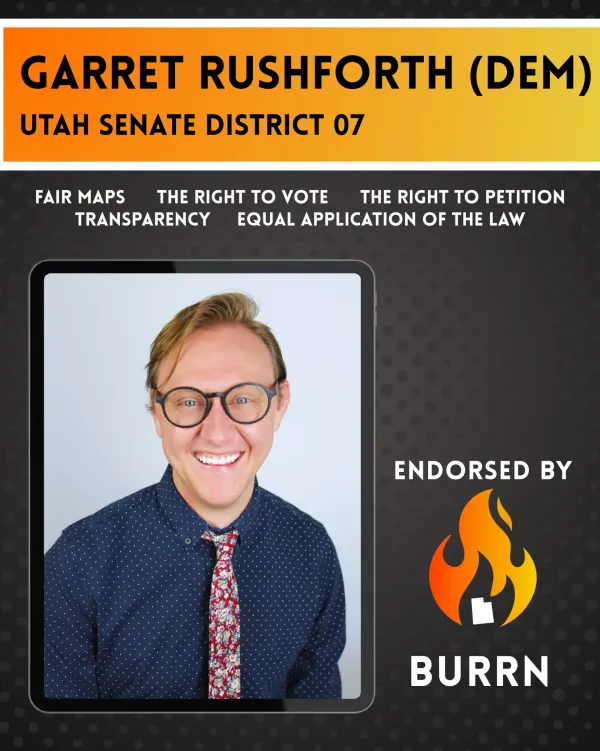
- Do you support or oppose the Independent Redistricting Commission and Standards Act that Utah voters approved in 2018? Please explain your reasoning.
- I fully and wholly support the Independent Redistricting Commission and Standards Act.
- Utah's politicians have spent a lot of time choosing their voters rather than representing them.
- The independent redistricting commission and standards act would create maps that would reduce partisan gerrymandering and giving utahns a real voice.
- It has been frustrating to see the state legislature ignore and abandon their responsibility to the voice of the people and instead create their own maps in contravention of the will of the people. Also, state legislative leaders claim that people are not experts in maps. But neither are they. I have studied mapping as part of my undergraduate degree in Geography, and I still would not call myself an expert. An independent commission is designed to allow experts to really address maps and partisanship in the state.
- What should happen when the legislature disagrees with a map the commission produces, and what would you do in that situation?
- Just as regular citizens are upset with laws but must still follow them, members of the legislature must also adhere to the law. In the situation that I disagreed with the map, I would approach the commission and discuss their methodology and potentially raise concerns with the public. But the commission should be the ones to draw maps for the legislature to choose from as is listed in the language of the bill.
- Do you support Utah's vote-by-mail system as it stands?
- Yes. It is one of the most accessible and effective voting systems in the United States.
- What would you do to encourage more people to vote who currently don't vote?
- I have gone around and personally helped people register to vote. I also like to remind them that they have a stake and voice in the success of our state and country. No vote equals no voice.
- Utah voters can put questions on the ballot through citizen initiatives and referenda. Should the threshold for passing them be changed? Why or why not?
- No. There are 104 legislators in the state of Utah. They pass laws for approximately 3.6 million citizens of the state. 75 Representatives and 29 Senators. Simple majority is good enough for them. I believe that simple majority for the 2.7 million voters in utah is a much higher bar for us to achieve and is not unreasonable to expect that to be sufficient to pass citizen initiatives.
- Additionally, the attempt to change the constitution is an attempt to silence the voices of millions of utahns. This is being done because the legislature doesn't like to be held accountable for bad legislation.
- What do you see as the relationship between transparency and corruption?
- Transparency is vital to combating corruption. But transparency alone isn't sufficient. Handshake deals seen through a window will still happen if there aren't enough consequences for corrupt activities.
- Transparency, however, makes it so that voters, law-enforcement, and other leaders may notice, call out, and act to hold accountable those corrupt leaders.
- Does Utah's GRAMA support the public's right to know, or does it need strengthening? Or is it too stringent?
- Utah's GRAMA does support the public's right to know. I think we have a robust and effective program that is regarded well by many groups across the state and country. It allows citizens to hold their leaders accountable and promote transparency.
- Describe a specific action you would take in office to make sure every person in your district has equal access to government services and equal protection under the law, regardless of citizenship status.
- I would propose a law that would keep members of ICE and other law enforcement agencies from entering government and public facilities without specific and judicially authorized authorization. While there are similar laws already, I would like to include more specific and severe consequences for any LEO that violates the rights of any member of the districts including unlawful arrests, bodycam deactivation, excessive force, etc. I would also sit down with each policing organization in my district and discuss the issues and discuss how to make sure the rights of citizens are protected to develop a relationship with them so that issues can be discussed and addressed quickly and legally.
- Is there anything else you think is relevant that our questions did not reach?
- Thank you for this opportunity.
- Each issue is nuanced and evolving and I will endeavor to continue to educate myself on each of these issues and the myriad others that will continue to arise.