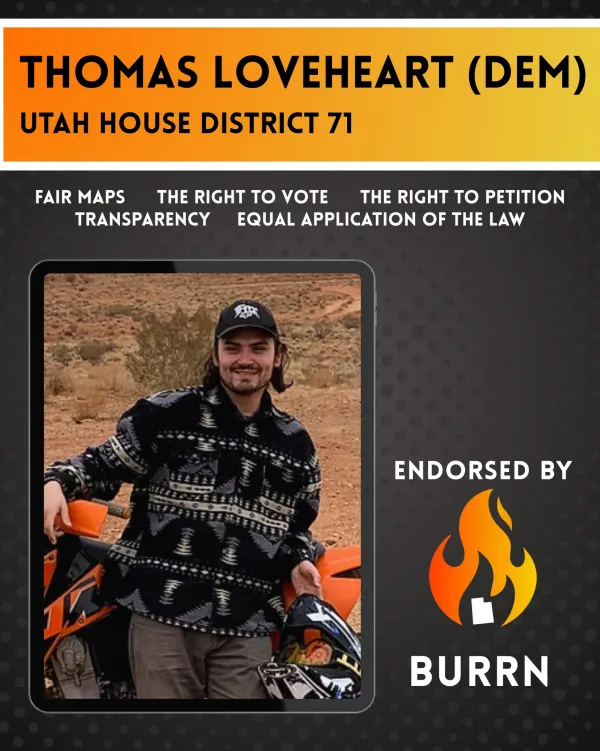
- Do you support or oppose the Independent Redistricting Commission and Standards Act that Utah voters approved in 2018? Please explain your reasoning.
- I support independent redistricting because elections should reflect the will of voters, not the interests of entrenched powers drawing their own districts. Proposition 4 passed in 2018 with bipartisan support, establishing standards designed to prevent districts from unduly favoring a party or incumbent.
- I believe legislators should respect laws approved directly by voters, even when those laws constrain their own power. The Legislature disagrees, willing to spend millions of taxpayer dollars to defend their unconstitutional power-grabs.
- Gerrymandering dilutes our voice and reduces accountability. I'll always support transparent, independent processes that keeps communities together, limit partisan manipulation, and puts voters first, not politicians.
- What should happen when the legislature disagrees with a map the commission produces, and what would you do in that situation?
- The Legislature is entitled to scrutinize a commission’s map, but disagreement should not be a license to simply draw whatever map serves their partisan interests. Any alternative should meet the same standards of fairness, transparency, public input, and protection against partisan favoritism established by Proposition 4.
- If elected, I would support the commission’s independence and judge any proposed map on those objective standards, not on whether it benefits my party or my own political interests. If the Legislature rejects a commission map, it should have to publicly explain why and demonstrate that its alternative better complies with the law and represents Utah’s communities. At the end of the day, Utahns voted for independent redistricting because they want a fair democracy without rigged maps. That's their right. Politicians who try to overturn that right don't deserve to represent Utah.
- Do you support Utah's vote-by-mail system as it stands?
- I support Utah’s vote-by-mail system and believe it has provided a secure, accessible way for Utahns to participate in elections. Currently, nearly 95% of Utahns rely on ballots delivered through the mail. If the Utah Republican Legislators depend on suppressing votes to protect their party, then they should change the platform, not attack one of the most foundational principles of our democracy. If elected, I would preserve automatic ballot delivery to active voters, maintain convenient rural drop-box access, and support policies that make voting easier without compromising security. Every state, including Utah, should focus on expanding participation while maintaining the safeguards that protect ballot integrity.
- What would you do to encourage more people to vote who currently don't vote?
- Most non-voters in Utah aren't apathetic. They've been taught that their vote doesn't matter. In a state like Utah where supermajority that frequently overrides voter-passed initiatives, attempts to sell-off public lands, defund schools, build Data Centers, and gerrymanders districts has ruled unopposed for decades in the legislature, it's hard to blame them.
- So the first step is earning back trust: respect the will of voters, draw fair maps, and adopt ranked-choice voting so people can vote their conscience without feeling like they're wasting it. Nearly half of Utahns are unaffiliated, and they deserve real choices.
- Second, make voting easy. I'd protect Utah's vote-by-mail system, expand drop boxes in rural areas, and support automatic and same-day registration.
- Finally, show up. Run on kitchen-table issues like housing, wages, and healthcare, and talk to people who've been ignored. People vote when there's someone on the ballot worth voting for.
- Utah voters can put questions on the ballot through citizen initiatives and referenda. Should the threshold for passing them be changed? Why or why not?
- Ballot Initiatives give citizens a direct voice in shaping the laws and policies that govern their lives. The initiative process exists as a check on government power, ensuring that when elected officials are unwilling or unable to act, the people can still bring forward ideas with broad public support. Many recent ballot initiative have been in direct response to a Legislature that governs as though it exists to rule rather than serve.
- Efforts by the legislature to weaken initiatives or make them harder to qualify undermine this fundamental democratic tool and concentrate more power in the hands of an already entrenched elite. If an idea can meet the clear, rigorous requirements to earn a place on the ballot, then voters—not politicians—should have the final say. Protecting the initiative process is about respecting the will of the people and preserving democracy in Utah.
- What do you see as the relationship between transparency and corruption?
- Corruption thrives in the dark. When the public can't see who is paying for a bill, who wrote it, or who profits from it, politicians serve donors while claiming to serve voters. Transparency is the most basic safeguard we have, because voters can't hold anyone accountable for what they can't see.
- In Utah, that means real campaign finance disclosure, with contributions reported quickly and in searchable form. It means stronger lobbying disclosure and ending the practice of lawmakers voting on issues where they have a financial stake. It also means open records laws and public meetings that aren't weakened every time they become inconvenient.
- Transparency doesn't fix everything on its own, but it makes the rest possible. If a legislator is proud of a vote, they should have no problem explaining it in public. And if they sell out their constituents for campaign donations from wealthy donors, they should go the way of former Senate President Stuart Adams.
- Does Utah's GRAMA support the public's right to know, or does it need strengthening? Or is it too stringent?
- GRAMA's core promise is sound: every person has the right to request government records. The problem isn't that it's too stringent. The Legislature keeps weakening it.
- In 2025, lawmakers made it nearly impossible to recover attorney fees even when a court finds an agency wrongly withheld records, and they moved to replace the State Records Committee, a volunteer panel whose rulings courts upheld about 98% of the time. These changes made it harder for ordinary Utahns to challenge a denial. Meanwhile, lawmakers' own records are largely shielded from the law they apply to everyone else.
- I'd restore the attorney fee protections, keep appeals fast and affordable, cap fees so cost isn't a barrier, and bring the Legislature under the same standards as every other public body. Legitimate privacy protections should stay. But government exists to serve the public, so the default should be openness.
- Describe a specific action you would take in office to make sure every person in your district has equal access to government services and equal protection under the law, regardless of citizenship status.
- I would sponsor legislation requiring every state agency serving our district to adopt and publish a language access plan, with trained interpreters, translated forms, and a clear way to file a complaint if services are denied. Too many people in rural Utah never get the help they're entitled to because they can't navigate the system, and that includes legal residents, citizens with limited English, and immigrant families.
- Equal protection also means safety. Crime victims and witnesses, including wage theft victims, must be able to come forward without fear, because a crime that goes unreported puts the whole community at risk. I'd push for stronger enforcement against employers who exploit workers, whatever their status and work to prevent local law-enforcement from collaborating with ICE.
- Is there anything else you think is relevant that our questions did not reach?
- Since Citizens United in 2010, billionaires and corporations have been able to pour unlimited dark money into our elections, drowning out the voices of regular people. Waiting for a Constitutional Amendment from politicians who benefit from this system isn't good enough.
- A legal movement in Maryland, the "Corporate Power Reset," offers a faster path. It doesn't challenge Citizens United. It bypasses it by using state corporate law. A corporation is an artificial entity created by the state, so the state can define the powers it grants. If a state-chartered corporation isn't given the power to spend in elections, its claimed right to do so doesn't matter.
- Utah should follow Maryland's lead and reclaim its authority over the corporations it charters. A national amendment should remain the goal, but Utah can act now to ensure our elections are decided by citizens, not the highest bidder. This is especially relevant in this era of full-fledged assault by hyperscale Data Centers across the state.