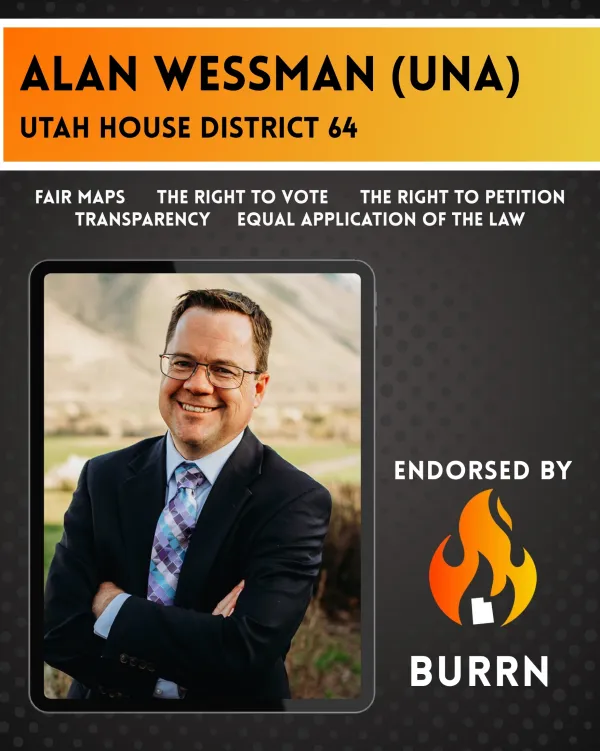
- Do you support or oppose the Independent Redistricting Commission and Standards Act that Utah voters approved in 2018? Please explain your reasoning.
- I strongly support it. I collected signatures for Prop 4 and was pleased when it made the ballot and passed. The independent redistricting commission part of it gets the most attention, and the commission did a praiseworthy job in 2021; but to me there is a more important part of the law. It is the part that establishes nonpartisan redistricting criteria and binds both the commission and the Legislature to follow those criteria.
- The law also balances out the legislature's authority in redistricting with the people's right to hold our government accountable. I believe the law was constitutional, fair, and beneficial to our system of representation in the state.
- What should happen when the legislature disagrees with a map the commission produces, and what would you do in that situation?
- By the terms of the law, the Legislature is free to decline the recommended maps from the independent commission. But it must explain how its own maps fit the legal criteria better, and provide that explanation to the public.
- If I were in that situation, where I preferred the Legislature's maps to the commission's, I would first make sure that the Legislature's maps indeed met the criteria better. If I could not honestly make that argument to the people of Utah, I would be obligated to vote for the commission's maps. If I could show that the Legislature's maps were better, then I would provide evidence for that and communicate it to the public.
- Do you support Utah's vote-by-mail system as it stands?
- I support vote-by-mail as a default voting method for Utahns, with the individual voter having the ability to opt out of receiving a ballot or to vote in person. I also support providing both the ballot drop-box and postal service methods of returning a ballot.
- I do not support making vote-by-mail an opt-in process, where voters actively have to request a ballot in order for it to be mailed to them. I would repeal the 2026 law that made it opt-in for elections after 2028.
- I also do not support requiring voters to affix postage to their ballot, or implying that postage is required. I would amend state law to require that ballot return envelopes clearly state that postage is not required.
- What would you do to encourage more people to vote who currently don't vote?
- The first thing to do is to understand people's reasons for not voting. Those can be varied, and collecting data on the underlying factors is essential to knowing how to craft solutions.
- For young people, barriers to voting may include being new to the process, moving residences frequently, and being unfamiliar with candidates and issues or their relevance to themselves. Personal outreach, voter registration drives, or even a "civic duty" phone app with reminders and info may be ways to address these.
- Some people are just fed up with politics and would rather avoid thinking about races, or see little point in voting because of pessimism about it making a difference. The way to reach these people is to demonstrate how to make a positive difference, and to offer a better choice on the ballot than what they're accustomed to. Make politics a less toxic area, show integrity, and give those people every reason to participate in the political process.
- Utah voters can put questions on the ballot through citizen initiatives and referenda. Should the threshold for passing them be changed? Why or why not?
- I do not support increasing the threshold from its current level, and for that reason I oppose this year's Amendment B which would set the threshold at 60% for certain initiatives.
- I would not decrease the threshold for initiatives either, because it's still achievable but pretty difficult to reach, which protects us from having a deluge of low-quality initiatives on the ballot each year. However, I support extending the time available to collect signatures for initiatives and referenda.
- I also support modifying the rules about which laws can be referred to the people. Right now, a law is exempt from the referendum if it passes by a 2/3 vote in both the House and Senate. I would remove this exemption if any such law only has support from legislators of a single party. In other words, unless a law gets votes from a minority party or from independent legislators, then it should be subject to referendum even if it reaches that 2/3 threshold.
- What do you see as the relationship between transparency and corruption?
- Corruption flourishes when there is a lack of accountability, and transparency is an essential element of public accountability. The people and the press have a constitutional right to be informed about the doings of our government, and to know how public monies are spent and how the powers of office are wielded.
- Does Utah's GRAMA support the public's right to know, or does it need strengthening? Or is it too stringent?
- The Government Records Access and Management Act (GRAMA) law is Utah's main transparency law for government operations. In recent years, it has been weakened by various changes that make it harder for the public and press to successfully request access to government records. One such change was to make it harder for citizens or members of the press to recover their legal fees when they successfully appeal a records denial. This ought to be reversed: if the denial was found to be without merit, then the state should bear the cost.
- Describe a specific action you would take in office to make sure every person in your district has equal access to government services and equal protection under the law, regardless of citizenship status.
- Firstly, I would have an office policy not to ask for a constituent's citizenship status unless it was directly relevant to their request. That would prevent them from being treated differently on that basis by myself or by my staff.
- Secondly, I would vote against any bill that conditioned government services or legal protections on a person's citizenship status, unless citizenship status was an inherent aspect of the service or protection (like obtaining a passport or running for office). Withholding social and health services, for example, from non-citizens is self-defeating policy that makes conditions worse by creating an underclass in our society susceptible to crime and poverty, and the costs of addressing those would far exceed what would be spent on extending the services in the first place.
- Is there anything else you think is relevant that our questions did not reach?
- For the record, my answers to this questionnaire are my own words, not AI-generated or assisted.