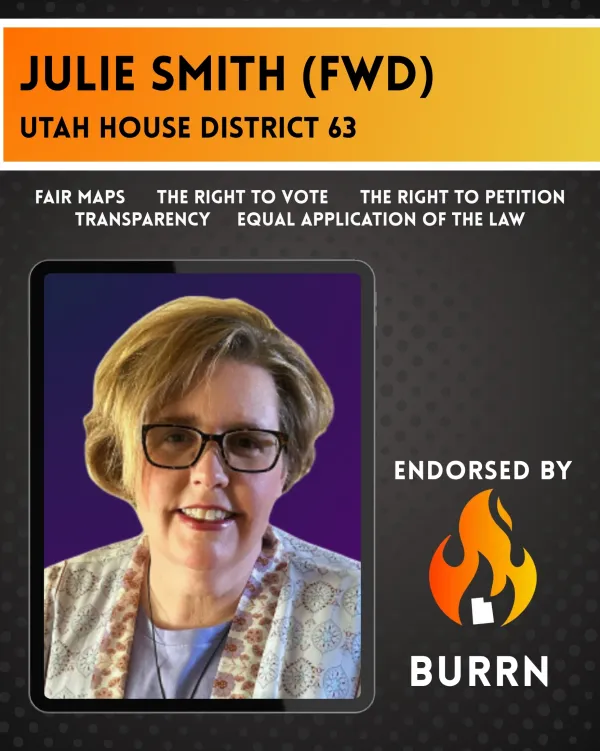
- Do you support or oppose the Independent Redistricting Commission and Standards Act that Utah voters approved in 2018? Please explain your reasoning.
- In 2018, a citizens initiative established the Independent Redistricting Commission and Standards Act. Citizens recognized that the boundaries that had been drawn were not truly representative and acted to correct it. Article 1, Section 2 of the Utah Constitution says that “all political power is inherent in the people,” and that “they have the right to alter or reform their government.” I support the idea of having neutral redistricting criteria used by an independent committee to ensure fairness in voting because it is the people’s right and their responsibility. All Utahns deserve to have their voice heard and to be represented equally.
- What should happen when the legislature disagrees with a map the commission produces, and what would you do in that situation?
- I would stand in strident opposition to this. Legislators do not have the right to draw maps to their liking. Ideally, the legislature should ensure that maps are fair, non-gerrymandered, and that each area is equally represented.That has not been the case in Utah for a long time. Ethical legislators should band together, listen to the will of the people, and ensure that the people maintain their right to equal representation. If this does not happen, Utah has already led the way with the 2022 court case and because of the quality of the people of Utah, they can be trusted to, once again, push for what is just, right, and fair. We must work to get ethical people in government who will make sure that the people retain their voice in government.
- Do you support Utah's vote-by-mail system as it stands?
- Yes, voting by mail is safe. Every audit of Utah’s vote by mail system has shown this.
- What would you do to encourage more people to vote who currently don't vote?
- People must first educate themselves on our governmental system. Once people realize how much trust our government places on the people, on them, and understand that the consequences for the people not doing their civic duty are incredibly serious, they should be inspired to educate themselves on the issues, completely and fully. We all need to understand the issues and what has led to them better so that we can fulfill our duties as a citizen. There is “no free lunch” in economics and there isn’t one in government either. Being an American is just as much about the responsibilities that come with citizenship as it is about the rights and privileges. When we unite together, “We the People” can take back our power from the extremists in both major parties - but it will take all of us, coming together and working through our differences, to make it happen.
- Utah voters can put questions on the ballot through citizen initiatives and referenda. Should the threshold for passing them be changed? Why or why not?
- Utahns should always have the right to create citizen initiatives and referendums. The people are the government. Legislators should never make it harder for the people they serve to have a voice in their government.
- What do you see as the relationship between transparency and corruption?
- Corruption counts on darkness. When processes are transparent and when the public demands transparency of act and ethical leadership, things can change. Shady dealings are not done in the light.
- Does Utah's GRAMA support the public's right to know, or does it need strengthening? Or is it too stringent?
- The public does have a right to information from our government. Ideally, government leaders would share what is happening and why out of their duty to their people as their public servant. Although this responsibility has eroded over the years, the people can request it.
- Describe a specific action you would take in office to make sure every person in your district has equal access to government services and equal protection under the law, regardless of citizenship status.
- The general public has not completely educated themselves on the law. The Constitution states that all people (not just citizens) have the protections of the rule of law. This means nobody is above the law and nobody is below it. The law is not a “respecter of persons” based on their wealth or personal characteristics, and it treats all people equally. The law is blind. The law is fair. Therefore, to preserve our government we must follow the law. One thing that would help is to educate the general public on what the law is and what it does. Educating oneself is a requirement of civic virtue and a responsibility of citizenship but the government should provide materials and encourage people to take this responsibility seriously, even if only to preserve itself.
- Is there anything else you think is relevant that our questions did not reach?
- If all Americans would recognize the need for civic virtue (willingness to sacrifice for the common good without expectation of personal gain) and choose to act on it continually and responsibly, we would be able to unite together and fix any problem. We must be motivated to take action and see the creation of positive change as our personal responsibility. We may not all be able to do everything but everyone can do something. The way through this is for each of us to reach out, selflessly, and work through our differences. It may not be easy and it may take some time, but improving ourselves, individually and collectively, is the way through this.