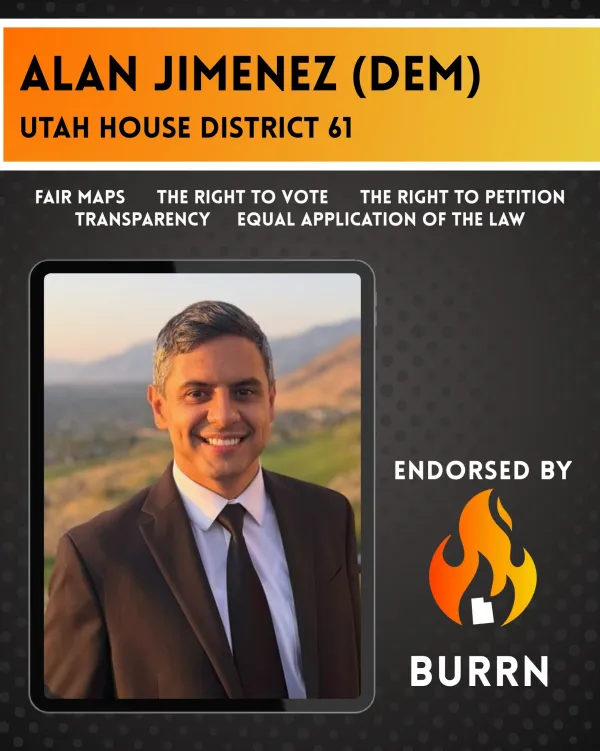
- Do you support or oppose the Independent Redistricting Commission and Standards Act that Utah voters approved in 2018? Please explain your reasoning.
- I support it. Voters passed Prop 4 in 2018 because they wanted fair maps drawn in the open. The legislature hasn't respected that. Lawmakers rewrote the law in 2020, threw out every map the commission drew, and passed their own map that split Salt Lake County four ways.
- Politicians shouldn't pick their voters. When the people drawing the lines are the ones who benefit from them, that's a conflict of interest. In cybersecurity, we'd never let someone audit their own system.
- The courts have sided with voters, and this year's repeal effort didn't make the ballot thanks to the effor of BURRN and so many great volunteers. I'll follow Prop 4 as written and vote against anything that weakens it.
- What should happen when the legislature disagrees with a map the commission produces, and what would you do in that situation?
- The legislature can disagree, but it should have to show its work. Under Prop 4, if lawmakers reject the commission's maps, their own map has to meet the same standards, and they have to explain in writing why theirs is better. That's fair. If their map really is better, they should be able to prove it.
- What shouldn't happen is what we saw in 2021, where every commission map was rejected, and a new map released and passed within a few days, leaving almost no time for public comment.
- If I disagreed with a commission map, I'd say why in public, ask the commission to address it, and only support an alternative that meets Prop 4's standards. And if my own party drew an unfair map, I'd vote no.
- Do you support Utah's vote-by-mail system as it stands?
- I support vote-by-mail, but not where it's headed. Mailing every voter a ballot has worked well in Utah. Turnout went up, and every ballot has a paper trail and a signature check.
- HB 300 ends that in 2029. Voters will have to opt in and renew every eight years, and ballots now have to arrive by Election Day instead of being postmarked. Those changes will mostly hurt people who move often or rely on slow mail, like UVU students, seniors, and shift workers.
- I work in cybersecurity, so I'm all for security changes that actually reduce risk. I haven't seen evidence that these do. I'd vote to keep automatic mail ballots and restore the postmark deadline, and I'm open to reasonable ID checks that don't keep eligible voters from voting.
- What would you do to encourage more people to vote who currently don't vote?
- Most people I talk to who don't vote aren't apathetic. They either don't think it matters or voting doesn't fit their lives. Both can be fixed.
- First, make it easy. Keep mail ballots automatic, add drop boxes near UVU and in west Provo, and do more outreach in Spanish. Help high school students preregister at 16 so they're ready at 18.
- Second, show that it matters. When the legislature overturns what voters pass, people learn their vote doesn't count. Respecting initiatives is a turnout issue.
- Third, show up. I'm knocking doors in neighborhoods that campaigns usually skip, and I'll keep holding events after the election, not just before it.
- Utah voters can put questions on the ballot through citizen initiatives and referenda. Should the threshold for passing them be changed? Why or why not?
- No. In Utah the power belongs to the people. Initiatives are how voters act when the legislature won't, and a simple majority is how we decide everything else.
- Amendment B on this year's ballot would require 60% to pass any initiative that raises taxes. The legislature can raise taxes with a simple majority. Lawmakers are asking voters to clear a higher bar than they set for themselves.
- It's part of a pattern. In 2018 voters passed Medicaid expansion, medical cannabis, and fair maps, and the legislature cut back or replaced all three. Now it wants to raise the bar before the next initiative. That's moving the goalposts, and it's a blatant power grab.
- I'm voting no on Amendment B, and I'll oppose any change that makes it harder for Utahns to petition their own government.
- What do you see as the relationship between transparency and corruption?
- Corruption depends on nobody watching. Transparency won't stop every bad actor, but it makes corruption harder to hide and easier to catch.
- I see this in my work every day. In cybersecurity, the systems that get breached are usually the ones with no logs or audits, so nobody notices until the damage is done. Government works the same way. If the public can't see who's giving money, who officials are meeting with, or why a bill changed overnight, problems don't get fixed. They grow.
- Transparency also has to come early. Posting a bill a few hours before the vote isn't transparency. People need time to read it and respond.
- That's why I support fast, searchable campaign finance disclosure, public schedules for elected officials, and strong public records laws.
- Does Utah's GRAMA support the public's right to know, or does it need strengthening? Or is it too stringent?
- It needs strengthening. GRAMA started from the right place. Government records belong to the public unless there's a good reason to keep them private. The problem is that it's gotten harder to actually use.
- In 2025 the legislature made two big changes. Now if you sue for records and win, you only get your legal fees back if you can prove the government acted in "bad faith." Most people can't take that gamble, and agencies know it. The legislature also got rid of the independent volunteer committee that handled appeals and handed that job to one person the governor appoints.
- I'd undo both. I'd also have agencies post commonly requested records online so people don't have to ask in the first place. And no, it's not too stringent. Things like medical records are already protected.
- Describe a specific action you would take in office to make sure every person in your district has equal access to government services and equal protection under the law, regardless of citizenship status.
- My mom came here from Peru and my dad from Spain, so this one is personal. I've seen how hard dealing with government can be when the forms aren't in your language and you're not sure who you can trust.
- One specific thing I'd do is sponsor a language-access bill. Every state agency would have to provide interpreters and translated materials for essential services, and people would have a simple way to report when that doesn't happen. Some agencies do this now, but it's inconsistent. A lot of families in west Provo and Orem speak Spanish at home, and they shouldn't miss services they qualify for or misread a court notice because of a language barrier.
- I'd run my own office the same way. Anyone in District 61 who needs help with a state agency will get it, and we won't ask about citizenship.
- Equal protection also means people can report a crime or go to court without fear. When people are afraid to call the police, everyone is less safe.
- Is there anything else you think is relevant that our questions did not reach?
- _(no response)_