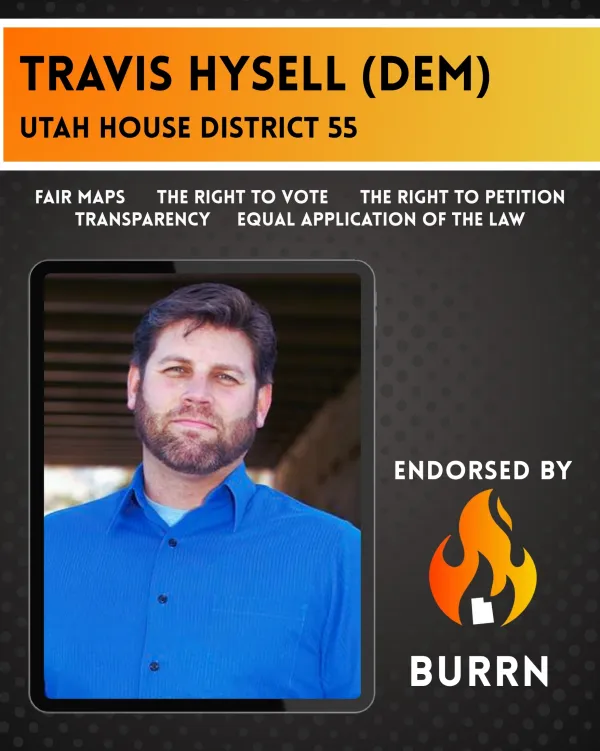
- Do you support or oppose the Independent Redistricting Commission and Standards Act that Utah voters approved in 2018? Please explain your reasoning.
- I strongly support Proposition 4, that Utah voters approved in 2018. Folks here in District 55 know what it feels like when decisions are made far away by powerful interests. We passed Prop 4 because we were tired of politicians drawing maps to protect themselves and their corporate donors. Fair maps are not a partisan issue, they are about communities like ours get a real voice. I oppose any effort to weaken, repeal, or ignore the will of the voters on this.
- What should happen when the legislature disagrees with a map the commission produces, and what would you do in that situation?
- The commission's map should be the default. The legislature should not be able to throw it out just because it prefers a map that protects incumbents or one party. If the legislature disagrees, it should have to meet aa incredibly high bar: a supermajority vote, written findings explaining how the commission map fails legal standards, public hearings, and court review. If I'm in the legislature, I would vote against any partisan map and support the independent commission's map. If the legislature tries to override the commission, I'll stand with the voters of District 55 and fight it.
- Do you support Utah's vote-by-mail system as it stands?
- Yes. Vote-by-mail is secure, convenient, and popular. It gives voters a paper trail, signature verification, ballot tracking, drop boxes, and early voting. I support keeping it and fully funding it. I will not support any effort to make voting harder for working people, older Utahns, or working class voters who rely on mail-in ballots because they work on election day.
- What would you do to encourage more people to vote who currently don't vote?
- I would support automatic voter registration at the DMV and other state agencies, same-day voter registration, pre-registration for 16- and 17-year-olds, and restoration of voting rights for people who have completed their sentences. I would expand early voting and ballot drop boxes in rural areas. I would invest in plain-language, multilingual voter education and partner with unions, community groups, and local schools. I also want to get corporate money out of elections. Powerful corporations and dark-money groups should not be able to buy our democracy. I support campaign finance reform, strong disclosure, and overturning Citizens United.
- Utah voters can put questions on the ballot through citizen initiatives and referenda. Should the threshold for passing them be changed? Why or why not?
- No. It should stay at a simple majority. Initiatives and referenda are how ordinary people check the legislature when it ignores us and leaves us out of the conversation. Raising the threshold to a supermajority would make it harder for working people to pass things like Medicaid expansion, redistricting reform, or anti-corruption measures. I would oppose any effort to raise the threshold, add burdensome signature requirements, or let the legislature gut an initiative after voters pass it.
- What do you see as the relationship between transparency and corruption?
- Corruption thrives in secrecy. When government records, meetings, contracts, and lobbying are hidden, powerful corporations and connected insiders get their way while the public is left in the dark. Transparency is how we hold elected officials accountable and make sure government works for working people, not just the wealthy and well-connected. We know that decisions about our land, water, and energy should not be made behind closed doors.
- Raising the threshold to a supermajority would make it harder for working people to pass things like Medicaid expansion, redistricting reform, or anti-corruption measures.
- Does Utah's GRAMA support the public's right to know, or does it need strengthening? Or is it too stringent?
- GRAMA supports the public's right to know in principle, but it needs strengthening. Recent changes have made it easier for government entities to delay, deny, and overcharge for records. I would support stricter response deadlines, narrower exemptions, fee waivers when disclosure serves the public interest, penalties for noncompliance, and strong records retention. The default should be disclosure. Exceptions should be narrow and justified.y
- Describe a specific action you would take in office to make sure every person in your district has equal access to government services and equal protection under the law, regardless of citizenship status.
- One specific action I would take is to sponsor the Equal Access to Public Services Act. This bill would prohibit any Utah state or local government agency from denying services, benefits, or protections based on a person's citizenship or immigration status, unless federal law explicitly requires it. It would also create a state Office of Language Access and Community Navigation with regional navigators—including one based right here in Duchesne or Uintah County—to help residents understand and access government services, file complaints, and get free interpretation.
- The bill would require every agency to post clear nondiscrimination policies, train staff on equal treatment and constitutional rights, and report annually on complaints and outcomes. I would fight to fund this office so rural communities like ours aren't left behind. This is about making sure that when someone needs help from the government—whether it's emergency assistance, a permit, victim services, or protection from a crime—they can get it without being asked for a passport or green card. That's what equal protection under the law means. It also helps everyone in District 55, because when our neighbors are safe and able to participate, our whole community is stronger.
- As a blue-collar progressive, I believe working people shouldn't be divided by immigration status. Powerful corporations and politicians use that division to keep us fighting each other instead of them. I'll always stand up for equal access and equal protection for every person in my district, no exceptions.
- Is there anything else you think is relevant that our questions did not reach?
- I'm a blue-collar progressive Democrat running for Utah House District 55. I'm known in activism circles as "Captain America". I don't come from corporate boards or donor networks, and I won't take corporate PAC money. All donations that I've recieved have come from individuals, unlike the incumbent I'm running against. I've seen how powerful corporations rig the rules while working people get stuck with the bill—whether it's fighting for fair wages in the oil fields, protecting our water rights, or making sure our rural schools get the funding they deserve. I'm running to put people over profits, protect democracy, and make government work for everyone—not just the wealthy few.