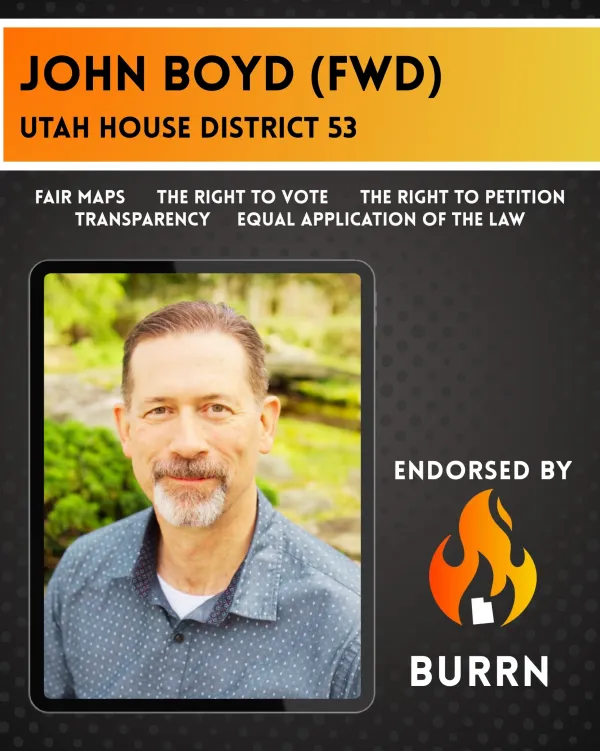
- Do you support or oppose the Independent Redistricting Commission and Standards Act that Utah voters approved in 2018? Please explain your reasoning.
- I support Prop 4, it's written in the Utah Constitution that the "People" can create ballot initiatives, and that's exactly what Prop 4 represents. I don't like what some in the legislature have done over the past few years to restrict Prop 4 and other citizen-led ballot initiatives. I'm against gerrymandering as well.
- What should happen when the legislature disagrees with a map the commission produces, and what would you do in that situation?
- If the legislature disagrees with a map produced by the independent commission, it should explain its objections publicly and base them on clear redistricting standards such as compactness, preserving communities of interest, minimizing city and county splits, and avoiding partisan favoritism. I would not reject a commission map simply because it was politically inconvenient. If I believed a map failed those standards, I would support sending it back for revision or considering an alternative that met the same neutral criteria.
- Do you support Utah's vote-by-mail system as it stands?
- Yes, it's been working fine for over 10 years with no evidence of significant fraud. I testified as a public citizen at the committee hearing against HB479, which would have required voters to hand deliver mail-in ballots.
- What would you do to encourage more people to vote who currently don't vote?
- The more elected leaders engage with the public in a positive way, the more they will want to get more engaged. When they see that leaders will listen to them, they will have more confidence that they can actually make change.
- Utah voters can put questions on the ballot through citizen initiatives and referenda. Should the threshold for passing them be changed? Why or why not?
- I support keeping the current majority-vote threshold for citizen initiatives and referenda. If citizens meet the significant requirements to qualify a measure for the ballot, I believe a majority of voters should be able to decide the outcome. Raising the threshold too high risks weakening the initiative process and making it harder for voters to act when they believe the legislature has not.
- What do you see as the relationship between transparency and corruption?
- Transparency and accountability go hand in hand. The more open government is about its decisions, spending, and potential conflicts of interest, the harder it is for corruption to take root. Public officials should expect their actions to withstand public scrutiny.
- Does Utah's GRAMA support the public's right to know, or does it need strengthening? Or is it too stringent?
- GRAMA is an important safeguard for the public’s right to know, and I support its basic framework. I would strengthen it where necessary to ensure that fees, delays, or overly broad exemptions don’t become barriers to legitimate public access. At the same time, we need to protect personal privacy, public safety, and genuinely sensitive information.
- Describe a specific action you would take in office to make sure every person in your district has equal access to government services and equal protection under the law, regardless of citizenship status.
- I would work to make sure state and local government services are accessible regardless of citizenship status by requiring clear, multilingual information about which services people are legally eligible to receive and how to access them. I would also support strong due-process protections so that everyone is treated fairly by government agencies and law enforcement, while respecting the legal distinctions that do exist between citizens and non-citizens.
- Is there anything else you think is relevant that our questions did not reach?
- _(no response)_