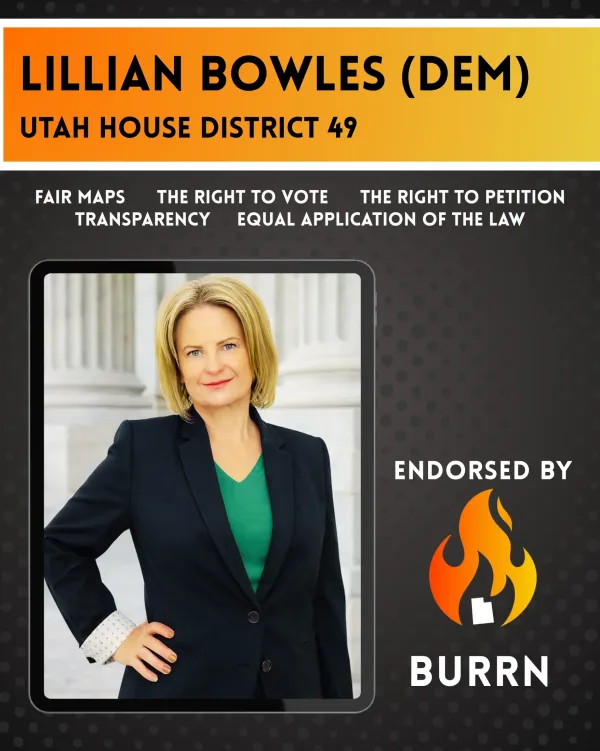
- Do you support or oppose the Independent Redistricting Commission and Standards Act that Utah voters approved in 2018? Please explain your reasoning.
- I support the Independent Redistricting Commission and the standards Utah voters approved through Proposition 4.
- I believe voters should choose their representatives, rather than elected officials choosing the voters who make it easiest for them to stay in office. Independent redistricting, clear standards, public participation, and transparency make our elections more competitive and our representatives more accountable to the people they serve.
- This issue is also bigger than any one map or political party. Utah voters used their constitutional initiative power to ask for a fairer process. I believe elected officials have a responsibility to respect that decision.
- The Utah Supreme Court's decision affirming that Utahns have a constitutionally protected right to reform their government through the initiative process reinforces something I believe strongly: political power ultimately belongs to the people.
- What should happen when the legislature disagrees with a map the commission produces, and what would you do in that situation?
- Disagreement by itself should not be enough to disregard the work of an independent commission.
- If there is a legitimate legal, constitutional, geographic, or technical problem with a proposed map, legislators should identify that problem publicly, explain it using the same neutral standards applied to every map, and allow the commission to address it.
- As a legislator, I would start with a strong presumption in favor of the independent commission's recommendation. I would not support replacing an independently produced map simply because another map creates a political advantage for my party or anyone else's.
- If I believed a commission map needed to be changed, I would explain specifically and publicly why, support an open process, and insist that any alternative meet the same neutral standards. Redistricting should serve Utah voters, not incumbent politicians.
- Do you support Utah's vote-by-mail system as it stands?
- I strongly support Utah's vote-by-mail system and preserving multiple secure ways for eligible Utahns to vote, including mail ballots, drop boxes, early voting, and Election Day voting.
- I do have concerns about recent changes that can make an otherwise valid ballot easier to reject, including requiring mailed ballots to be received by Election Day rather than using a timely postmark. Election security and voter access should not be treated as competing goals. We can protect both.
- Any election-law change should be based on evidence of an actual problem, developed with county clerks and election professionals, communicated clearly to voters, and evaluated for whether it unnecessarily prevents eligible Utahns from casting a ballot that will be counted.
- My standard is straightforward: make voting secure, accessible, understandable, and trustworthy.
- What would you do to encourage more people to vote who currently don't vote?
- I think we first have to understand why people don't vote. For some, it is a practical barrier. For others, it is a lack of information, distrust, or a belief that government does not listen to them anyway.
- As a representative, I would work on both sides of that problem.
- I would support accessible registration and voting, clear nonpartisan voter information, adequate ballot drop-off and in-person voting options, accommodations for voters with disabilities, and outreach that reaches people where they are.
- I also believe elected officials have a responsibility between elections. I plan to hold regular town halls, communicate clearly about what is happening at the Legislature, make myself accessible to constituents, and actively seek input from people who may not normally participate in government.
- People are more likely to participate when they believe their voice actually matters. Rebuilding that trust is part of the job.
- Utah voters can put questions on the ballot through citizen initiatives and referenda. Should the threshold for passing them be changed? Why or why not?
- I support keeping the current standard that an initiative or referendum is decided by a majority of voters, and I do not support raising the threshold required for passage.
- Utah already has substantial requirements for getting an initiative before voters, including statewide signature requirements and significant geographic distribution requirements. Those safeguards ensure that an initiative demonstrates meaningful public support before it ever reaches the ballot.
- The initiative and referendum powers are especially important when elected officials are unwilling to address an issue that voters believe requires action. They are not a loophole around representative government. They are part of Utah's constitutional system of government.
- Once an initiative has qualified for the ballot and a majority of Utah voters approve it, I believe elected officials should respect that decision rather than looking for ways around it.
- I would be open to improvements that make the initiative process clearer, more transparent, and easier for voters to understand, but I would oppose changes whose practical effect is to make citizen participation more difficult or to override the will of a majority of voters.
- What do you see as the relationship between transparency and corruption?
- Transparency is one of the strongest protections we have against corruption and abuse of power.
- Most government decisions involve public money, public authority, or both. The public should be able to understand who influenced a decision, how public money was spent, what information officials relied upon, and who benefits from government action.
- Transparency does not mean that every record can or should be public. There are legitimate reasons to protect personal information, victims, personnel information, security matters, and other sensitive records. But secrecy should be the exception that government must justify, not the default.
- Transparency also matters before corruption occurs. When elected officials know their decisions, communications, financial relationships, and use of taxpayer dollars can be scrutinized, it creates accountability before something goes wrong.
- I believe public trust has to be earned, and open government is essential to earning it.
- Does Utah's GRAMA support the public's right to know, or does it need strengthening? Or is it too stringent?
- GRAMA is an important foundation for the public's right to know, but I believe it can be strengthened.
- The goal should be meaningful access, not technically allowing access while making records prohibitively expensive, unnecessarily difficult to locate, or so delayed that the information is no longer useful.
- I would support clearer presumptions favoring disclosure of public records, reasonable response times, reasonable limits on fees, strong access to records involving public spending and government decision-making, and a fair and workable appeals process when requests are denied.
- I would also support better proactive disclosure. When information such as budgets, contracts, expenditures, votes, meeting materials, and other commonly requested public records can reasonably be posted online, people should not always have to file a GRAMA request to obtain it.
- At the same time, GRAMA must continue protecting legitimate privacy and safety interests. The goal is not disclosure for its own sake. It is accountable government and a public that can see how decisions made in its name are being made.
- Describe a specific action you would take in office to make sure every person in your district has equal access to government services and equal protection under the law, regardless of citizenship status.
- One concrete action I would take is to establish a constituent-services process that is available to every resident of House District 49, not just people who voted for me, belong to my political party, or are eligible to vote.
- If someone who lives in my district is trying to navigate a state agency, understand a government process, find an available service, or determine where they need to go for help, my office should help them.
- I would also advocate for accessible government information, language access where it is needed, disability access, and clear information about eligibility requirements for state programs and services.
- Citizenship may legally affect eligibility for particular programs or rights, including voting, but it should never determine whether a person is treated with dignity, receives accurate information from their government, can report a crime, can seek assistance from an elected representative, or receives the equal protection of the law to which they are entitled.
- Government should be understandable and accessible to the people it serves.
- Is there anything else you think is relevant that our questions did not reach?
- My commitment to these issues comes from a broader belief about public service: government derives its authority from the people, and that authority comes with an obligation to be accountable to them.
- I did not grow up believing government or institutions were necessarily accessible to people like me. I came from poverty and an isolated community, later became a first-generation college graduate, raised a family, cared for family members, worked in business, and served refugee and immigrant communities through AmeriCorps VISTA.
- Those experiences shaped how I think about representation. People should not need money, political connections, specialized knowledge, or the right last name to have access to their government.
- If elected, I want to help build a culture in which constituents can see what their government is doing, understand why decisions are being made, participate meaningfully in those decisions, and hold elected officials, including me, accountable.