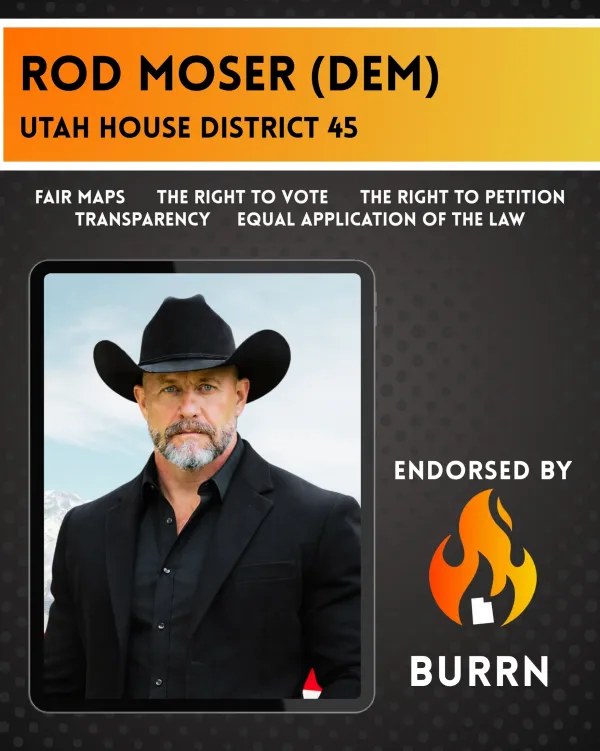
- Do you support or oppose the Independent Redistricting Commission and Standards Act that Utah voters approved in 2018? Please explain your reasoning.
- I support it. In 2018, Utah voters passed Proposition 4 to create an independent commission with clear, neutral rules for drawing district lines. Voters should choose their leaders, and leaders should not choose their voters. When the Legislature made the commission advisory only in 2020, a Utah court ruled it violated the people’s right to reform their government by initiative, and I agree. This year, a repeal effort failed after many Utahns removed their names from the petition, which shows people still want fair maps.
- When voters pass a law, the Legislature should respect it. Competitive districts push every candidate, Republican or Democrat, to listen to the whole community. As a legislator, I will protect Prop 4, oppose efforts to override it, and support funding the commission so it can do its job.
- What should happen when the legislature disagrees with a map the commission produces, and what would you do in that situation?
- When the Legislature disagrees, it should say why in public and stick to the same rules. Under Prop 4, the Legislature can vote on the commission’s maps. If it rejects one, any map it draws instead must meet the same neutral standards, and lawmakers must explain in writing why their version does a better job. That keeps the process honest and gives voters a clear record to judge.
- If I disagreed with a commission map, I would judge it only on the standards: keeping communities and cities together, equal population, and fair treatment of both parties. I would explain my concerns openly, ask the commission to address them, and support a fix done in public hearings. I would not vote for any map drawn behind closed doors or to protect one party, including my own.
- Do you support Utah's vote-by-mail system as it stands?
- I support vote-by-mail, but I have concerns about where it is headed. Utah’s system works. It is popular with voters of every party, it raises turnout, and our county clerks run it well. I think asking voters to add the last four digits of their ID to the ballot envelope is a reasonable step that builds confidence, and I give the Legislature credit for that. My concern is the 2029 change that ends automatic mail ballots and makes every voter opt in, then opt in again every eight years. That adds paperwork to a system that already works, and the people most likely to fall through the cracks are seniors, young voters, and busy working families.
- As a legislator, I would keep the ID check and keep sending ballots to every active registered voter automatically. I would also make sure voters clearly know that mailed ballots must now arrive by 8 p.m. on Election Day, so no one’s vote gets thrown out over a mail delay.
- What would you do to encourage more people to vote who currently don't vote?
- People vote when they believe their vote matters and when voting is easy. Many Utahns stopped voting because they watched the Legislature override laws that voters passed, like Proposition 4, or saw big decisions handed to boards nobody elected. I would work to rebuild that trust by respecting ballot initiatives, supporting fair maps that make races competitive, and being open about how and why decisions get made. I would also protect what already works: keep mailing ballots automatically to every active voter, keep plenty of drop boxes, and make sure every voter knows the deadlines.
- On a personal level, I would keep doing what my campaign does now: knock on doors, listen, and show up in every part of the district, not just the neighborhoods that already vote. I would also support stronger civics education in our schools so young people learn how local government affects their lives, from housing costs to school funding. When people see the direct line between their vote and their family’s future, they show up.
- Utah voters can put questions on the ballot through citizen initiatives and referenda. Should the threshold for passing them be changed? Why or why not?
- No. The threshold should stay at a simple majority, and I oppose Amendment B. Majority rule is how the Legislature passes laws, including tax increases, so the people should be held to the same standard. Under Amendment B, initiatives that create or expand a tax would need 60% of the vote. None of Utah’s 2018 initiatives reached 60%, so Medicaid expansion and medical cannabis, which voters approved, would have failed. The amendment would also apply the 60% bar to initiatives that lower property tax rates, which makes it harder for voters to cut their own taxes.
- I understand why some lawmakers want a higher bar on taxes, and I share the goal of protecting Utah families from costs they can’t afford. Fair taxes is one of my campaign pillars. But the answer to a tax you don’t like is to vote no. Voters have already shown they can tell a good idea from a bad one, and the Legislature has tried again and again to weaken that power. I trust Utah voters, and I will work to keep the initiative process strong and fair.
- What do you see as the relationship between transparency and corruption?
- Transparency is the best protection against corruption, because people behave better when they know the public is watching. Most problems in government start small: a decision made behind closed doors, a meeting posted where no one will see it, or a board that answers to no voter. Something can be legal and still leave the public in the dark. In Utah, unelected authorities like MIDA and the Inland Port Authority control billions of dollars in development and tax money, yet most residents have never heard of them and can’t vote anyone off those boards. When people can’t see how decisions are made, trust breaks down, and that opens the door to abuse, even when no one has done anything wrong yet.
- As a legislator, I would push for clear, easy-to-find public records, meeting notices people can actually find, and plain-language reports on where tax dollars go. I would also support putting elected officials, who answer to voters, in charge of the boards that spend public money. Good people in government have nothing to fear from sunlight, and it helps the public tell the difference between honest mistakes and real problems.
- Does Utah's GRAMA support the public's right to know, or does it need strengthening? Or is it too stringent?
- GRAMA has a strong foundation, but recent changes have weakened it, and it needs strengthening. For more than 30 years, GRAMA gave everyday Utahns a fair, low-cost way to see how their government works. In 2025, the Legislature replaced the seven-member State Records Committee, which included citizens, media, and local government, with a single director appointed by the governor. It also passed HB 69, which makes it hard for people who win a records case in court to get their legal fees back unless they prove the government acted in bad faith. The old committee did have a real backlog, and lawmakers were right to want faster answers. But the fix should have been more staff and clear deadlines, without putting so much power in one person or making it so expensive to fight a denial.
- As a legislator, I would restore a balanced citizen panel to hear appeals, let people recover their legal costs when they win, and fund the records office so it can meet its deadlines. I would also make sure every board that spends public money, including development authorities like MIDA, answers records requests quickly and in plain language. When records are easy to get, honest public servants have nothing to fear and voters can trust what they see.
- Describe a specific action you would take in office to make sure every person in your district has equal access to government services and equal protection under the law, regardless of citizenship status.
- I would sponsor a language access bill so every Utahn can understand and use the government services they’re entitled to. The bill would require state agencies and local governments to offer free interpreters and translated forms for essential services like courts, police reports, public schools, health programs, and housing assistance. When a mother can’t read a school notice, or a crime victim can’t explain what happened to an officer, they lose equal protection in practice, no matter what the law says on paper. Everyone who lives here pays taxes, works, and raises families in our communities, and the law should protect all of them the same way. Crime victims and witnesses especially need to feel safe coming forward, because that keeps the whole neighborhood safer.
- In my own office, I would lead by example. I would hold regular community office hours in South Jordan, White City, and Sandy with interpreters available, and make sure my office helps any constituent who calls, without asking about their status first. Good government starts with people knowing they can walk through the door.
- Is there anything else you think is relevant that our questions did not reach?
- Yes. One issue that ties all of these questions together is the growing number of unelected authorities in Utah. Boards like MIDA, the Utah Inland Port Authority, and the Point of the Mountain State Land Authority make big decisions about land, development, and tax dollars, yet voters can’t elect or remove the people who run them. These boards often follow the law and post their notices, but most residents never hear about their decisions until the bulldozers show up. I believe anyone spending public money should answer to the public. In office, I would push to put elected officials in charge of these boards, require plain-language reports on where the money goes, and make their records easy to request.
- I also want you to know I’m running a volunteer-driven campaign because I believe government works best when regular people show up. I know this questionnaire is arriving late, and I understand if that affects my eligibility for your endorsement. Either way, I stand with you and love the work you do to protect fair maps, open records, and every Utahn’s voice. Thank you for holding all of us who run for office to a higher standard.