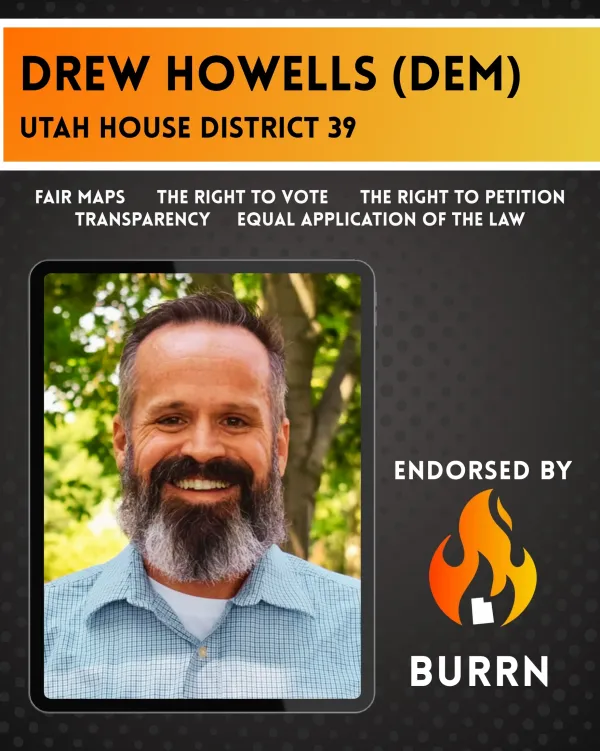
- Do you support or oppose the Independent Redistricting Commission and Standards Act that Utah voters approved in 2018? Please explain your reasoning.
- I support the Independent Redistricting Commission and Standards Act approved by Utah voters in 2018.
- For me, this is fundamentally a question of who should choose whom in a representative democracy. Voters should choose their representatives. Representatives should not be able to choose their voters.
- Proposition 4 created an independent redistricting commission and established standards intended to make the process more transparent, less partisan, and more accountable to the public. Among other things, the initiative required consideration of communities of interest, compact and contiguous districts, municipal and county boundaries, and prohibited drawing districts for the purpose of unduly favoring or disfavoring a political party, incumbent, or candidate. It also required greater public access to proposed maps and the information used to create them.
- Those are not partisan principles. They are democratic principles.
- I also believe this issue goes beyond redistricting. Utah voters used their constitutional initiative power, gathered the required signatures, made their case to their neighbors, and won an election. The Legislature subsequently repealed and replaced substantial portions of the voter-approved law through SB 200 in 2020. That pattern— voters acting through the initiative process only to have the Legislature significantly alter what they approved — has deeply damaged public trust.
- I helped draft and organize around Proposition 2, Utah’s medical cannabis initiative, so I have experienced this issue personally. I believe the initiative power exists precisely because legislative power is not supposed to be absolute.
- Fair maps should not depend on which political party happens to control the Legislature in a particular decade. Democrats should not draw maps to protect Democrats, Republicans should not draw maps to protect Republicans, and incumbents should not be allowed to engineer districts around their own political survival.
- Redistricting should serve voters, communities, and representative government. I support an independent commission and enforceable, transparent standards because democracy works best when elected officials have to earn their voters— not select them.
- What should happen when the legislature disagrees with a map the commission produces, and what would you do in that situation?
- Disagreement by itself is not a problem. The Legislature should be able to raise legitimate concerns about a commission map, especially if there is a constitutional, Voting Rights Act, population, geographic, or community-of-interest issue that needs to be addressed. What I do not support is allowing “we disagree” to become an excuse for legislators to throw out an independent process and draw a politically convenient map of their own.
- If the Legislature believes a commission map is flawed, those objections should be specific, public, and supported by evidence. The commission should have an opportunity to respond and, when appropriate, revise the map while still following the same transparent standards.
- What should not happen is a closed-door process where legislators simply replace the commission’s work with a map designed around partisan advantage or incumbent protection.
- As a legislator, I would begin with the expectation that the commission’s work should be respected. If I believed there were legitimate problems with a proposed map, I would identify those problems publicly and work through the commission process to correct them. I would not support rejecting a map simply because it creates a district that is politically inconvenient for me, my party, or another incumbent.
- An independent commission means very little if elected officials can ignore it whenever they do not like the political outcome. The Legislature still has a constitutional role in redistricting, but that role should be exercised as a public trust, not as an opportunity for self-preservation. If legislators want to depart from a commission recommendation, they should have to explain exactly why, show the evidence supporting that decision, and do it in full view of the public.
- Voters should choose their representatives. Representatives should not be drawing lines to protect themselves from voters.
- Do you support Utah's vote-by-mail system as it stands?
- Yes to vote by mail. No to what the Legislature is doing to it.
- Utah built one of the best election systems in the country. Every active registered voter got a ballot at home, had time to read it, and sent it back. Turnout went up. Voters in both parties used it and liked it. Then, in 2025, the Legislature passed HB 300 and started taking it apart.
- A ballot now has to be in the clerk’s hands by 8 p.m. on Election Night— a postmark no longer counts. This year, voters have to write ID digits on the return envelope. In 2029, the automatic ballot ends— you will need a state ID and have to opt in, then opt in again every eight years.
- None of that fixes a problem voters asked anyone to fix. It adds steps, and every added step drops people— seniors, renters who move, rural voters. Service members have voted by mail since the Civil War. If it is secure enough for a soldier overseas, it is secure enough for a grandmother in Midvale.
- I will work to restore automatic mail ballots for every active voter and the postmark deadline, and I will vote against any bill that makes voting harder.
- What would you do to encourage more people to vote who currently don't vote?
- People who don’t vote are not lazy. Most of them did the math and decided it doesn’t change anything— and in Utah, they have evidence.
- They watched voters pass ballot initiatives and the Legislature rewrite them. They watched districts get drawn so the outcome was settled before a single ballot went out. Then they got told the problem is apathy.
- You bring people back by making their vote count, then making it easy to cast. Count first. I will defend the independent redistricting voters approved in Proposition 4, and I will treat a passed initiative as an instruction, not a suggestion. Foregone conclusions keep people home.
- Then easy. Keep a ballot in every active voter’s mailbox, and fund voter education before the 2029 opt-in catches people who never heard about it.
- And show up. Campaigns pull lists of likely voters and skip every other door, so the people who feel ignored get ignored again. I will hold town halls in West Jordan, Sandy, and Midvale, answer for my votes in person, and keep knocking doors in the years when my name is not on the ballot. People vote when they believe someone on the other end is listening.
- Utah voters can put questions on the ballot through citizen initiatives and referenda. Should the threshold for passing them be changed? Why or why not?
- No. A majority is a majority. It takes a simple majority of legislators to pass a law, and it should take no more than that for the people they work for.
- The Legislature can raise your taxes with a simple majority vote on a Tuesday afternoon. This November, it is asking voters to hold themselves to 60 percent for doing the same thing by initiative. Under that rule, Medicaid expansion would have failed in 2018, when about 53 percent of Utahns voted for it.
- I was part of the team that passed Proposition 2. I know what it takes to get a question in front of voters— signatures across 26 of 29 Senate districts, years of work, and money most citizen groups never find. In 2018, voters passed three initiatives, and the Legislature amended all three. The bar is already high. The people raising it are the ones the process exists to check.
- Initiatives and referenda are what Utahns use when the Legislature won’t listen. I will vote no on the 60 percent amendment, oppose any new supermajority or signature hurdle, and oppose any amendment handing the Legislature power to repeal what voters pass.
- What do you see as the relationship between transparency and corruption?
- Corruption doesn't start with a bribe. It starts with a closed door. Transparency is what raises the price of walking through it.
- I was trained as a military journalist and served in public affairs. The rule we worked under was maximum disclosure, minimum delay. You tell the public what you are doing with their money and their trust, fast, even when it is embarrassing— especially then. An institution that hides small things is practicing for the big ones.
- Utah's Legislature has been moving the other way. When a court ordered the attorney general's work calendar released, lawmakers sealed every official's calendar. Last year they abolished the State Records Committee, a volunteer panel whose rulings courts upheld 98 percent of the time, and replaced it with a single appointee. They also made it harder to recover legal fees when you win a records fight. Each change makes secrecy cheaper and asking questions more expensive.
- I will work to reopen official calendars, restore an independent records panel and fee recovery, and put authorities like MIDA under State Auditor oversight. Officials who are doing the public's business honestly lose nothing when the public can see it.
- Does Utah's GRAMA support the public's right to know, or does it need strengthening? Or is it too stringent?
- It needs strengthening— mostly by undoing what the Legislature has done to it.
- GRAMA, as written in 1991, was a good law. It starts from the presumption that government records belong to the public, and it includes a balancing test that allows a record to be released when the public’s interest outweighs the government’s reason for hiding it. In 2025, lawmakers tried to strip that test out and backed down only after Utahns pushed back.
- What they did pass caused enough damage. The volunteer records committee is gone, and appeals stalled during the handoff to a single governor-appointed official. A requester who wins in court now has to prove bad faith to recover legal fees, meaning an agency can wrongly deny a request and leave an ordinary person stuck with the bill. Officials’ work calendars are also sealed.
- I would defend the balancing test against the next attempt to weaken it. I would bring back a multi-member appeals panel with seats for the public and the press, restore fee recovery for people who successfully challenge an improper denial, reopen official calendars, and put real consequences behind the response deadlines already written into law.
- In 2011, the Legislature gutted GRAMA, and Utahns forced a repeal within weeks. People here care about this law. Their representatives should too.
- Describe a specific action you would take in office to make sure every person in your district has equal access to government services and equal protection under the law, regardless of citizenship status.
- The Fourteenth Amendment does not say citizen. It says no state shall deny to any person within its jurisdiction the equal protection of the laws. When I served in the military, I swore an oath to that Constitution, and it did not come with an asterisk.
- My specific action is a bill I have already drafted: the Utah Surveillance Privacy and Accountability Act. Police agencies across Utah now use license plate cameras and AI-assisted tracking tools under rules that have not kept up with the technology. My bill requires a case number and written justification for every search, a warrant before anyone maps a person’s movements or associations, and a ban on vendors selling the data. Those rules would bind every agency that wants access to the database and protect every person in it.
- That matters for equal access because fear closes doors that are legally open. A family that believes the government is tracking them stops calling 911, stops reporting a landlord or employer who cheats them, and stops walking into a clinic or school office.
- My office will work the same way. If you live in House District 39, you are my constituent. Nobody will ask for your papers before we help you.
- Is there anything else you think is relevant that our questions did not reach?
- Two things.
- First, I come to these issues as a citizen who has used the tools you defend. I was part of the team that passed Proposition 2, and I helped draft the Medical Cannabis Act that followed. I have seen the initiative process from both sides; what it takes for ordinary people to force an issue onto the ballot, and what happens once the Legislature gets hold of it.
- As co-chair of the state Veterans Caucus, I held no elected office. We built the case, found sponsors, and won expanded college access for veterans and a USO in the new Salt Lake airport.
- Second, this seat is winnable. In 2022, the precincts in House District 39 chose Evan McMullin over Mike Lee on the same ballot that reelected my opponent. These voters split tickets. My campaign is grassroots; no out-of-state group money and no outside spending on my behalf; and volunteers have knocked more than 3,000 doors.
- I am running because I still believe government can be worthy of the people it serves. Every answer on this form is a commitment, and I expect you to hold me to it.