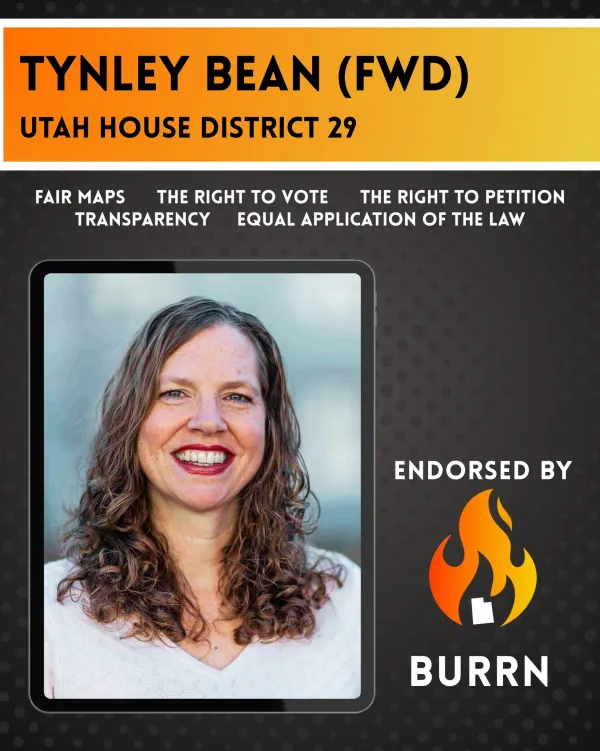
- Do you support or oppose the Independent Redistricting Commission and Standards Act that Utah voters approved in 2018? Please explain your reasoning.
- I support the 2018 Independent Redistricting Commission and Standards Act because elections should be decided by voters, not manipulated through partisan map-drawing. Upholding these standards ensures fair representation, protects local communities, and restores public trust in our democratic institutions.
- What should happen when the legislature disagrees with a map the commission produces, and what would you do in that situation?
- When the legislature disagrees with an independent commission, the decision must be guided by public interest, not political self-preservation. As a public servant, I would insist on total transparency, requiring lawmakers to publicly justify any departure from objective, anti-gerrymandering standards and ensuring the fundamental right of voters to fair representation is always respected.
- Do you support Utah's vote-by-mail system as it stands?
- I support a secure and accessible vote-by-mail system because it honors Utah's tradition of high voter participation and civic engagement. Mail-in voting provides vital convenience for working families, seniors, and rural citizens while maintaining rigorous verification standards to protect ballot integrity. As state policies and administrative requirements continue to update, my priority remains ensuring that every eligible voter can easily participate in a transparent, trustworthy electoral process.
- What would you do to encourage more people to vote who currently don't vote?
- To combat the widespread feeling among Utah voters that their ballots don't matter, we must also address how primary elections are conducted. In many areas, closed primaries sideline independent and unaffiliated voters from participating in taxpayer-funded elections that often decide the ultimate winner. By moving toward open primaries, combined with alternative voting methods like ranked-choice voting, we can dismantle barriers that cause voters to feel disenfranchised. This ensures that every citizen has a voice in every stage of the election, incentivizes candidates to appeal to a broad majority rather than narrow factions, and revitalizes public trust in our democracy.
- To truly get ahead of voter apathy, we need to cultivate a culture of civic duty long before citizens reach voting age. As an elected official, I support investing in early civic education—such as hands-on mock elections, school programs, and interactive learning starting as early as elementary school. By demystifying the voting process and making participation a familiar, exciting part of growing up, we can build a foundation of lifelong civic engagement and ensure future generations approach the ballot box with confidence and pride.
- Utah voters can put questions on the ballot through citizen initiatives and referenda. Should the threshold for passing them be changed? Why or why not?
- I firmly oppose changing the threshold to pass citizen-initiated ballot measures. The initiative process is a vital constitutional safety valve—a direct check created to give everyday Utahns a voice when the legislative process falls short. Raising the threshold to a 60% supermajority fundamentally shifts the balance of power away from the people and gives an unfair advantage to special interests and institutional inertia. If a measure earns a clear majority of votes from the citizens of our state, it should become law. We should be protecting citizens' constitutional rights to self-governance, not erecting higher walls to block them.
- What do you see as the relationship between transparency and corruption?
- The relationship between transparency and corruption isn't just about whether data exists—it’s about whether that data is actually usable. Right now, a lot of information is technically public, but it's buried in complex disclosures and bureaucratic hurdles. When citizens feel like they need a forensics team just to understand how decisions are made, it breeds fatalism. People sense corruption, feel overwhelmed, and throw their hands up in apathy. To fix this, transparency cannot just be passive data-dumping; it has to be proactive, clear, and user-friendly.
- But transparency without teeth isn't accountability. The data and rules already exist, but someone who wants to hide something can wait out a sluggish review process or bank on the fact that enforcement is spotty and depends on luck (whether someone bothers to investigate).
- I would propose the following changes:
- Automated flagging system. Stop waiting for humans to notice. Create a simple dashboard that automatically flags when a legislator votes on bills connected to their disclosed interests. Make it visible to voters.
- Automatic escalation on incomplete filings. If a form is incomplete after notice, it automatically goes to the attorney general for review within a set timeframe. No discretion to let it slide.
- Stricter enforcement timeline. Make the attorney general's office report back within 90 days on what action they're taking (or why they're not).
- Real consequences for false disclosures. Right now violations feel theoretical because penalties are rarely applied. Making even one high-profile enforcement case happen would change the behavior.
- Does Utah's GRAMA support the public's right to know, or does it need strengthening? Or is it too stringent?
- Utah's transparency law (GRAMA) has been hollowed out. The law says records are public unless exempted, but we now have 83 exemptions and lawmakers add more nearly every year. Even worse, enforcement is weak. High administrative fees can block access as effectively as outright denial, the State Records Ombudsman lacks real enforcement power, and agencies don't face consequences for delaying or ignoring records requests.
- This directly enables corruption. If no one is checking compliance, if fees make it too expensive for ordinary citizens to verify what officials are doing, if electronic communications can disappear into private email accounts, then transparency becomes theoretical rather than real.
- I'd strengthen GRAMA by capping exemptions, setting reasonable fee limits, giving the Records Ombudsman actual enforcement authority with penalties, and requiring automatic attorney's fees for successful challenges. Most importantly, I'd apply the same principle as my Impact Audit Initiative: transparency with teeth and consequences, not transparency that depends on luck or persistence.
- Describe a specific action you would take in office to make sure every person in your district has equal access to government services and equal protection under the law, regardless of citizenship status.
- Every person in my district deserves fair treatment under the law and access to basic protections, regardless of citizenship status. I would take four specific actions:
- First, I would work with local law enforcement to ensure that crime victims and witnesses can report crimes without fear that providing information will result in deportation. When people won't report crimes, our entire community becomes less safe.
- Second, I would support legislation ensuring that anyone facing court proceedings in our district has access to legal representation. People deserve their day in court and a fair trial.
- Third, I would require state agencies serving our district to clearly communicate which services do not require proof of citizenship or immigration status. Right now, fear and confusion prevent people from accessing emergency care, food assistance, and other services. Transparency about people's actual rights is a basic part of good government.
- Fourth, I would advocate for funding legal aid organizations serving rural counties. Millard County has the highest immigration caseload per capita in Utah but almost no access to lawyers.
- Is there anything else you think is relevant that our questions did not reach?
- As an elected official, I commit to being accessible and transparent. I will hold regular town halls, publish my voting record, and remain responsive to constituent concerns.
- I will also push for comprehensive campaign finance reform. Money in politics distorts accountability, and we need real limits on corporate influence and special interest donations so representatives answer to constituents, not donors.
- My Impact Audit Initiative addresses transparency at the state level: any bill or incentive over $4 million must set measurable goals upfront, tracked publicly through a dashboard, with automatic sunset if goals aren't met. But transparency and accountability must extend to local government too.
- Public Infrastructure Districts in my district exemplify the problem. They operate with minimal disclosure, no measurable infrastructure goals, and little public oversight. I will push legislation requiring PIDs to provide clear upfront disclosure, establish specific, measurable infrastructure goals at creation, implement automatic sunsets if goals aren't met, and create a state transparency dashboard so voters can see what they're paying for and what results they're getting.
- Transparency with teeth and consequences—not just wishful thinking—is how we restore public trust in government at every level.