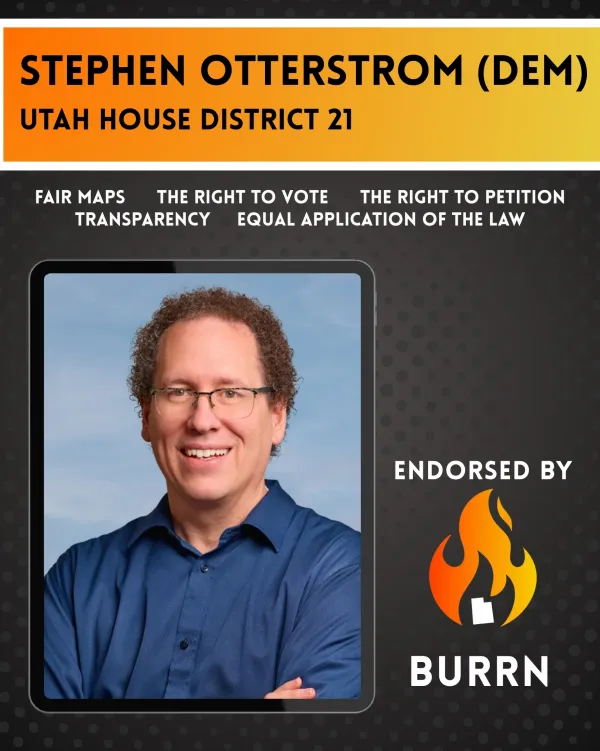
- Do you support or oppose the Independent Redistricting Commission and Standards Act that Utah voters approved in 2018? Please explain your reasoning.
- Yes. The key to democracy is that voters choose their representatives, not that representatives choose their voters.
- What should happen when the legislature disagrees with a map the commission produces, and what would you do in that situation?
- I agree with what the law currently requires, which is that the legislature can adopt its own map. However, it must follow the same standards. Even more important than the commission are the standards because they give citizens a way to challenge gerrymandered maps, no matter who drew them. I would oppose adopting a map that fails those standards. I would also support changing the process so that, when the commission and the legislature disagree, the legislature submits one map and the commission submits another for voters to choose between in a statewide vote. Both maps would have to meet the applicable legal standards.
- Do you support Utah's vote-by-mail system as it stands?
- Yes
- What would you do to encourage more people to vote who currently don't vote?
- First off, voter registration should be automatic for all eligible citizens. Voting rights should be irrevocable. Ranked-choice voting should be expanded to all elections.
- Utah voters can put questions on the ballot through citizen initiatives and referenda. Should the threshold for passing them be changed? Why or why not?
- The threshold is already very difficult to reach. If it were to be changed, it should be to make it easier, not harder.
- What do you see as the relationship between transparency and corruption?
- Transparency is one of the most effective methods for rooting out corruption. However, many of the things we call transparent are not really accessible. For example, records may be priced beyond an ordinary person's means, released too late to influence a decision, or provided in an unnecessarily difficult-to-use format.
- Does Utah's GRAMA support the public's right to know, or does it need strengthening? Or is it too stringent?
- It needs to be strengthened, including restoring the public's right to obtain the work calendars of public employees and elected officials through GRAMA. Calendars documenting public business should be accessible, with narrow redactions for genuinely private appointments and sensitive personal information.
- Describe a specific action you would take in office to make sure every person in your district has equal access to government services and equal protection under the law, regardless of citizenship status.
- Recognize that equal protection must also mean equal access. Currently, our legal system favors the wealthy and well connected. Eliminating cash bail would be a big step. I would also support repealing Utah's state-imposed requirement that public employers and covered public contractors use E-Verify or another status verification system for new hires. Federal Form I-9 requirements and any applicable federal E-Verify obligations would still remain only because as a state representative I have not power to change them. We should protect noncitizens from having to declare their status when renting a home or seeking assistance.
- Is there anything else you think is relevant that our questions did not reach?
- Underfunding public programs like education is oppression. It is time to fight to get things done that actually will improve people's lives.