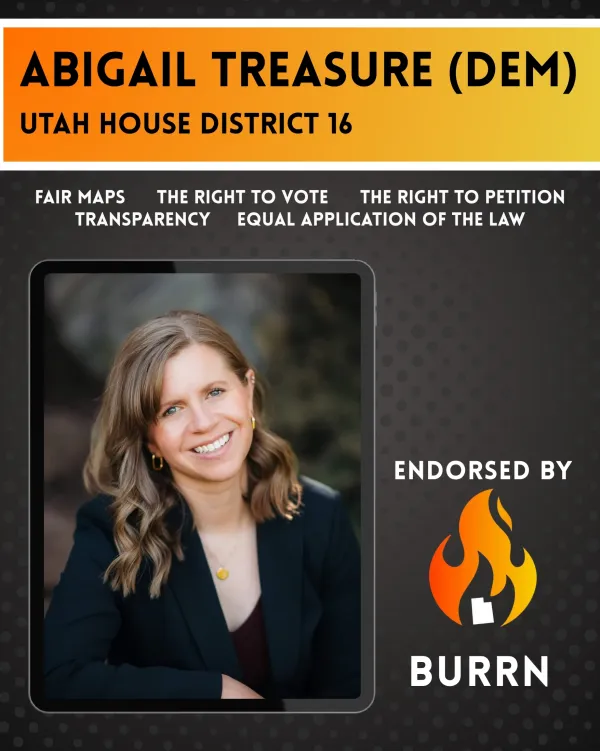
- Do you support or oppose the Independent Redistricting Commission and Standards Act that Utah voters approved in 2018? Please explain your reasoning.
- I support the Independent Redistricting Commission and Standards Act, which Utah voters approved in 2018. Utah's citizen-led ballot initiative process has a high threshold for qualifying and passing measures. The voice of the people should be respected.
- Voters should choose their representatives, not the other way around. Fair maps are essential to a healthy democracy because they help keep political power in the hands of the people.
- Utah's longstanding Republican legislative supermajority has had considerable power over drawing its own electoral boundaries, creating an inherent conflict of interest. An independent redistricting process helps limit politicians' ability to manipulate district boundaries to preserve their own power and helps ensure voters have a meaningful voice in choosing their representatives.
- Legislative districts should keep cohesive communities together as much as possible so that the members of those communities are represented by someone that is in touch with the issues they are facing.
- What should happen when the legislature disagrees with a map the commission produces, and what would you do in that situation?
- If the legislature disagrees with a map produced by the commission, it should have to identify specific ways the map fails to meet the requirements of the Independent Redistricting Commission and Standards Act. If those concerns are legitimate, the commission should have an opportunity to address them and produce a revised map.
- If disagreements remain, any maps considered by the legislature should comply with the Act’s standards and be evaluated on fairness—not on which party or incumbent stands to benefit. This may require independent or judicial review. Disagreements should be resolved through a transparent, rule-based approach, not political bargaining.
- As a legislator, I will prioritize fair maps and the public’s right to choose their representatives. If the commission produces a map that meets the requirements of the Act, I will vote to approve it.
- Do you support Utah's vote-by-mail system as it stands?
- Yes! I support Utah’s vote-by-mail system and believe we should continue it. Vote-by-mail makes voting more accessible for people who have difficulty getting to the polls, have demanding work or family schedules, or face other barriers to voting in person.
- As a voter, I appreciate having my ballot at my kitchen table, where I can carefully review each candidate and ballot measure from the comfort of my home and take the time I need to make informed decisions.
- Utah’s election system includes safeguards such as signature verification, ballot tracking, secure ballot handling, and post-election audits. Voters can also return their ballots at secure drop boxes or vote in person if they prefer. These options help make voting accessible while protecting the integrity of our elections. I support continuing this system so every eligible Utahn has a meaningful opportunity to make their voice heard. Vote by mail has increased voter participation substantially. Democracy works best, when everyone participates!
- What would you do to encourage more people to vote who currently don't vote?
- I would focus on both rebuilding trust in our democracy and making it easier for people to participate. A statewide, nonpartisan get-out-the-vote campaign could reinforce the message that every vote matters and help voters understand how to participate.
- We also need fair electoral maps. When voters believe district boundaries are designed to protect politicians rather than represent communities, they may feel their participation won't make a difference. Fair maps help ensure voters have a meaningful voice in choosing their representatives.
- Finally, I would support voter registration efforts in high schools and colleges, along with education about the voting process. Research suggests that establishing voting habits early can encourage participation throughout adulthood. Voting should be accessible, understandable, and something every eligible Utahn feels empowered to do.
- Utah voters can put questions on the ballot through citizen initiatives and referenda. Should the threshold for passing them be changed? Why or why not?
- The threshold should not be changed. The threshold is already very high. It takes a massive, statewide effort to get a citizen initiative on the ballot. The requirement that the 8% voter threshold must be met in 26/29 of the senate districts ensures that initiatives that make it to the ballot, have statewide, rather than just regional support.
- It is a very high bar to clear, and requires significant volunteer efforts and voter outreach as is. Once it is on the ballot, the choice should be up to the people of Utah to decide by a simple majority.
- What do you see as the relationship between transparency and corruption?
- Trust in Utah's elected officials is low right now, and a lot of that has to do with the lack of transparency. Wether elected officials are dealing in corruption or not, is hard to know due to the lack of transparency. Many deals are made behind closed doors and without opportunity for public comment. It would be hard for law makers and other elected officials to participate in corruption, if their actions were fully transparent.
- Utahns deserve a seat at the table. They should have access to their representatives and to information regarding decisions they are making. We can restore Utahns trust in their elected officials by restoring transparency.
- Does Utah's GRAMA support the public's right to know, or does it need strengthening? Or is it too stringent?
- GRAMA supports the public’s right to know and strikes an important balance between government transparency and protecting sensitive information. I don’t believe it is too stringent. It provides public access to government records while protecting legitimate privacy interests. Transparency is essential to government accountability and public trust.
- Describe a specific action you would take in office to make sure every person in your district has equal access to government services and equal protection under the law, regardless of citizenship status.
- I would support legislation requiring state and local government agencies to provide clear, consistent guidance on access to services regardless of citizenship status, consistent with the law. Access to this guidance should not be limited by language or disability, all should be able to equally access the information they need to navigate government services. Everyone deserves to be treated with dignity and fairness when interacting with their government, and no one should be denied services they are legally entitled to receive because of who they are or where they were born.
- Is there anything else you think is relevant that our questions did not reach?
- _(no response)_