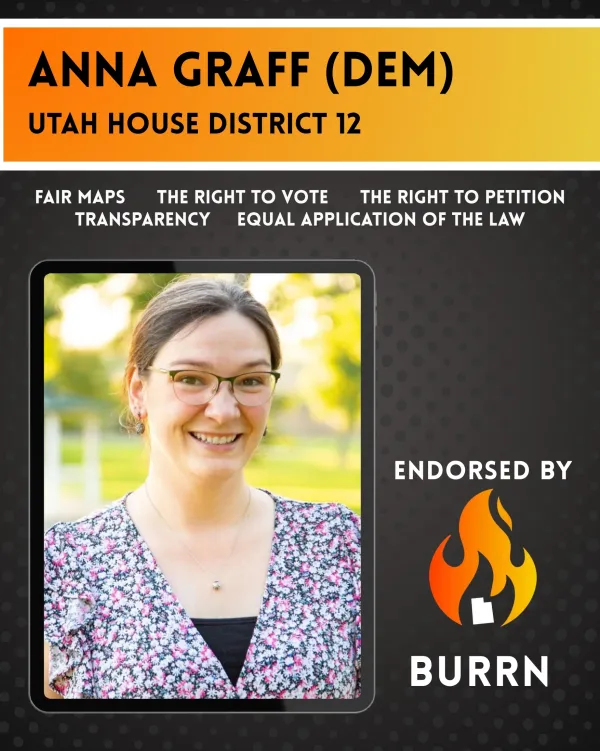
- Do you support or oppose the Independent Redistricting Commission and Standards Act that Utah voters approved in 2018? Please explain your reasoning.
- I am in support of this act. There are few avenues for elevating the voice and decisions of the people outside of voting for our representation. This Act worked to preserve the voice of the people and protect against actions of the legislature to gerrymander and push out opposing voices. I deeply support measures that give oversight and accountability to leadership, and protect the voice and will of the people.
- What should happen when the legislature disagrees with a map the commission produces, and what would you do in that situation?
- If there is disagreement from the legislature regarding a map that the commission has produced, and if the commission is non-partisan, appointed through fair and lawful means, granted mapping authority through lawful means, (such as the decision of the people in Prop 4), and the map meets all requirements, the legislature has a responsibility to either adopt the proposal, or proceed through the lawful process for developing and adopting an alternative. If the legislature wants to reject the map, they must provide a map that complies with the initiative's neutral redistricting standards, and explain why their map better satisfies the requirements established by Proposition 4. The legislature should not wield its power to override the processes in place, or alter them to circumvent the will of the people. It cannot use its legislative authority to circumvent or impair the voter-approved redistricting process and standards protected by the Utah Constitution. I am committed to upholding the voter-approved process and as a legislator, I would vote and fight against maps/measures that circumvent or nullify such acts and the voices of the people. As a Utah resident, I have worked to inform and educate those around me regarding this issue, reached out to my representatives, and empowered others to speak during public comment opportunities during legislative sessions, and to contact their representatives as well.
- Do you support Utah's vote-by-mail system as it stands?
- Overall, yes, I support the vote-by-mail system. But there are areas that I would address for improvement - specifically the element requiring a ballot be received by 8:00pm on Election Day to be counted. This change was implemented for the current cycle creating a new requirement for voters to understand and account for when returning mailed ballots. While there has not been a confirmed number of state-wide ballots received after the 8pm deadline, we know that at least 101 were received late in Summit County. This change may also disproportionately impact voters living on reservations with limited access to Election Day voting locations and inconsistent mail service.
- I have toured Weber County's election office, and talked with election officials at County and State levels and have found our vote-by-mail system to be quite secure and proactive.
- What would you do to encourage more people to vote who currently don't vote?
- I have been going door-to-door and speaking with residents - asking questions about policy impacts and concerns, and providing information about registering, checking current registration, and why this year is vastly different than previous years for Utah elections - almost every seat has a challenger this year and residents have more choice than we have had in decades. Many of the candidates this cycle are accessible and invested in bringing the voices and needs of the people into the decision-making space. Helping connect voting to personal impact makes a significant difference for those who haven't felt like voting mattered previously.
- Utah voters can put questions on the ballot through citizen initiatives and referenda. Should the threshold for passing them be changed? Why or why not?
- I do not support increasing the threshold for passing or qualifying initiatives/referenda for the ballot. But I do support reducing the current requirements for ballot qualification. Utah's citizen initiative and referendum process already carries substantial and demanding requirements. Regarding Amendment B for the upcoming election, I am firmly in the "vote no" position as this amendment raises the threshold from a simple majority to 60% for certain tax-related statewide initiatives. Utah's Constitution dictates a majority vote to pass initiated legislation (with the exception of wildlife related initiatives requiring two-thirds majority). I am not in support of changes that put more power in the hands of the legislature by taking it from the people, and I feel this amendment would create additional hurdles to an already excessively stringent process.
- What do you see as the relationship between transparency and corruption?
- Reduced transparency creates a breeding ground for corruption. Transparency is an essential safeguard against corruption; reducing it weakens public oversight and accountability.
- Does Utah's GRAMA support the public's right to know, or does it need strengthening? Or is it too stringent?
- Utah's Grama system supports the public's right to know. Although there are waivers available, I recognize that the potential cost associated with filing a GRAMA request can be a deterrent and barrier for many Utahns.
- Describe a specific action you would take in office to make sure every person in your district has equal access to government services and equal protection under the law, regardless of citizenship status.
- The 4th, 5th, and 14th amendments of the United States Constitution grants equal protections and due process to "persons", including citizens and non-citizens. Every person is entitled to these constitutional protections; the 14th extends equal protection and due process when state government is involved, and the federal government is similarly constrained by the 4th and 5th amendments. Every person is entitled to these constitutional protections. My responsibility as a legislator is to ensure that government applies laws consistently, fairly, and constitutionally to every person in the district. While state or federal law may establish citizenship requirements, I will evaluate and fight against policies that conflict with due process and constitutional protections, regardless of a person's citizenship or immigration status. I am currently working on framework for policy that would dictate requirements/restrictions for Utah entities interacting with federal entities built from the Supreme Court's anti-commandeering doctrine, and current state law from 12 other states. For example - restriction of state and local resources so they can’t be used to facilitate a federal civil-immigration arrest, search, detention, or transfer without judicial warrants. Utah personnel and resources will not participate unless specified legal safeguards are satisfied. Recently passed legislation addressing cooperation must be amended and accountability and safeguards established. Regarding access to government services, improving accessibility and language access to resources; funding community services specifically devoted to assisting with immigration law and services; pushing statewide “sensitive location” legislation designating medical, spiritual, and educational facilities as safe locations with restrictions on actions without judicial warrants. At bare minimum, presenting a resolution with a clear breakdown of restrictions/protections that can be implemented at the county and municipal level would create guidance on record for the entire state of what those councils and commissions can do, even if it doesn’t pass.
- Is there anything else you think is relevant that our questions did not reach?
- I am determined to enact ethics reform legislation that includes a strict recusal process for legislators with a conflict of interest. If a legislator stands to profit from a policy decision, they should not be permitted to propose legislation in relation to that area, or to vote on its passing.
- I am committed to strengthening accountability and transparency for our leadership, while also doing the work and research required to identify my own areas of impact blindness and policy knowledge weaknesses.