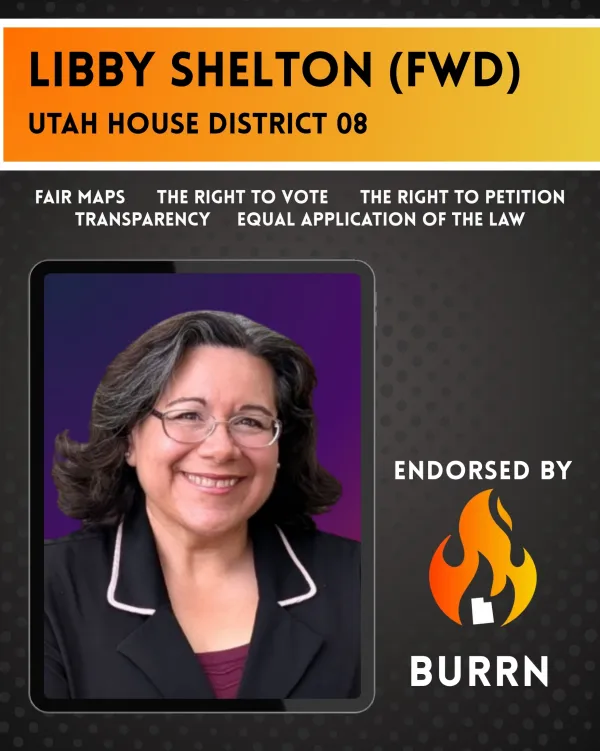
- Do you support or oppose the Independent Redistricting Commission and Standards Act that Utah voters approved in 2018? Please explain your reasoning.
- I support the Independent Redistricting Commission and Standards Act.
- The legislature should not be picking their constituents. It is a means for certain organizations to consolidate power and escape accountability rather than their constituents being chosen by fair maps that give the people more power to hold their representatives accountable.
- What should happen when the legislature disagrees with a map the commission produces, and what would you do in that situation?
- When the legislature disagrees with a map the commission produces they should clearly state their specific objections, not a blanket objection, and the commission should determine if those concerns and any proposed changes could be incorporated within the guidelines of a fair map.
- If this is not able to be resolved, the objections of the legislature should be posted in a public place for a reasonable length of time that it can be seen by the public and a process should be put in place for appropriate mediation.
- Personally, I would likely defer to the commission regarding their guidelines on what constitutes a fair map.
- Do you support Utah's vote-by-mail system as it stands?
- I support Utah's vote by mail system as it stands prior to recent legislative changes, like requiring ballots be requested as of 2029.
- What would you do to encourage more people to vote who currently don't vote?
- I think the best way to encourage people to vote is to show them that voting matters by upholding what the people have voted for. In addition, I think giving them candidates for whom they feel can trust will also encourage people.
- Ultimately, I would also support the work of organizations like The League of Women Voters.
- Utah voters can put questions on the ballot through citizen initiatives and referenda. Should the threshold for passing them be changed? Why or why not?
- I do not believe the threshold for citizen initiatives and referenda should be changed. The current rigor of even getting an initiative on the ballot, along with the fight to inform the public provides Utahns with the needed vetting for the current threshold to be fair.
- What do you see as the relationship between transparency and corruption?
- A lack of transparency provides a space for temptation and breeds corruption. Transparency is needed to keep the corruption in politics at bay.
- Does Utah's GRAMA support the public's right to know, or does it need strengthening? Or is it too stringent?
- This is a more difficult question, GRAMA does support the public's right to know, but may seem too stringent while protecting individual private information. I say this thinking that many things surrounding the rights of private individuals involved in criminal justice or other systems. This one would require more thought and research on my part to answer definitely.
- Describe a specific action you would take in office to make sure every person in your district has equal access to government services and equal protection under the law, regardless of citizenship status.
- I would introduce legislation at the state level requiring DHS enforcement in Utah be required to show their faces to receive assistance from law enforcement in Utah. I would also introduce legislation requiring that they provide evidence that an immigrant is dangerous as proven by a violent criminal record before requesting assistance from local law enforcement.
- Is there anything else you think is relevant that our questions did not reach?
- Thank you for the opportunity.