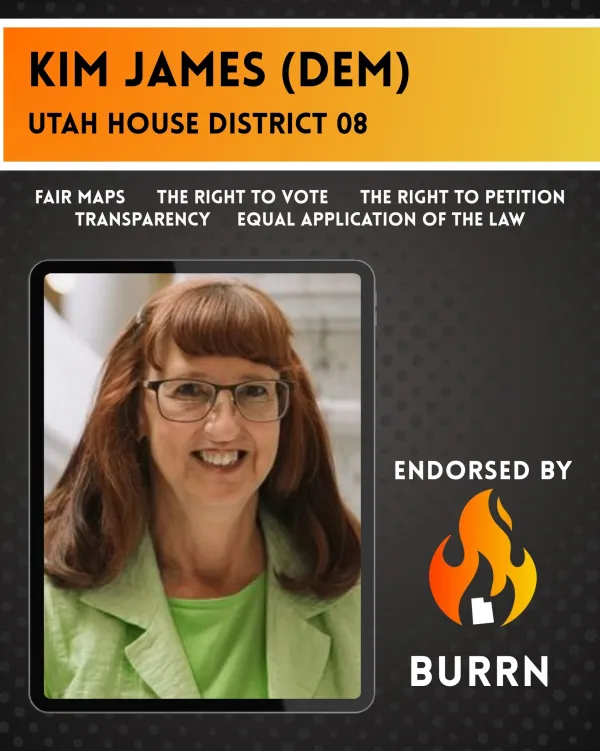
- Do you support or oppose the Independent Redistricting Commission and Standards Act that Utah voters approved in 2018? Please explain your reasoning.
- Absolutely! I was in the room for the Legislative Hearing when the Independent Redistricting Commission presented the options they had worked so diligently to create with input from across the state. I saw their colorful PowerPoint slides, and--like so many Utahns--was deeply disappointed when the Legislature rejected and fought against the work they had done. Utah needs fair districts because the outcomes are, to some extent at least, predetermined and rigged by how the lines are drawn. As I'm out campaigning, it's clear to me that most Utahns want some kind of middle ground on most issues. So many Democrat-minded people have had to register as Republicans to even have a voice in who gets elected. A number of people of spoken with were surprised I was out knocking on doors because they assumed the election was over after the June primaries. This isn't how a democracy should function. Fair districting would go a long way toward balancing out the leadership to match the will of the people.
- What should happen when the legislature disagrees with a map the commission produces, and what would you do in that situation?
- First of all, the Independent Redistricting Commission was formed because the people of Utah voted for it. Secondly, they were a balanced group of people on that Commission. Thirdly, they did a thorough job at traveling through the state and talking with the people everywhere. Fourthly, they took their responsibility seriously and did careful work that was worthy of respect. Those should have been adequate reasons for the Legislature to appreciate the Commission's efforts and adopt one of their suggested map options. If the Commission had done sloppy work, all of Utah would have been up in arms. That would have been an awkward situation. But, if that had been the case, Utahns would have understood the Legislature's need to adapt and perfect the poorly prepared map options. Because the citizens voted for an Independent Commission, I suggest that the remedy would be to release the Commission members who didn't take their job seriously and to select a new Independent Commission to do this perfecting work. The job of the Legislature would be to follow through with the intent of the voters who wanted an independent process to produce fair maps.
- Do you support Utah's vote-by-mail system as it stands?
- Yes! Vote by mail is an excellent way to run an election! I think it is reasonable to ask for an identification number along with a signature. But I can imagine that some persons, maybe the elderly and disabled, might need assistance to comply. I'm not a fan of the new law that will soon require citizens to update their request for mail-in ballots. Surely some people will forget or fail to make that request, and they will become disenfranchised because they won't be aware of what happened. I think mailing ballots to every active registered voter is the best way to keep our democracy strong.
- What would you do to encourage more people to vote who currently don't vote?
- I think we should proclaim www.vote.utah.gov from the housetops! We should put it on billboards. In the months before an election, we should have digital ads about it. It should be in TV ads. Continue mailing out ballots to every active registered voter. While door knocking for my campaign, I've encountered lots of parents of young adults who are away from home at college or on a church mission. The parents don't know what will happen with their young adult child's ballot. They don't know if it will come to the family home, if they should forward the mail, or if the young adult will receive it and return it in time to have their vote counted. With so many young adult Utahns away on missions or at college, maybe there could be more education for them and their parents about how to vote.
- Utah voters can put questions on the ballot through citizen initiatives and referenda. Should the threshold for passing them be changed? Why or why not?
- No, the threshold should be 50% +1, just like it is in the state legislature. It's tremendously hard to even get an initiative or referendum on the ballot. By the time it reaches the ballot, it has already undergone significant public scrutiny. If it passes even with "just" a simple majority, that's a huge win.
- What do you see as the relationship between transparency and corruption?
- I've read and heard multiple news stories about research done on what happens when local newspapers shut down. The same would be true for other forms of media. When the citizens are less informed, they participate less in the democratic process, political corruption increases, and crime rises. We need to know what's going on.
- Does Utah's GRAMA support the public's right to know, or does it need strengthening? Or is it too stringent?
- I am not knowledgeable about the specifics of Utah's GRAMA laws, and so I don't really have an opinion about this. In general, though, government must be accountable to the people. I really appreciate what Utah Auditor Tina Cannon and her staff have been doing to make public and transparent the actions of our Utah government in the website https://transparent.utah.gov/ .
- Describe a specific action you would take in office to make sure every person in your district has equal access to government services and equal protection under the law, regardless of citizenship status.
- I would make it easier to get appointments with knowledgeable, qualified Workforce Services staff. I would update the Workforce Services website to improve its usefulness and user friendliness. i would make it easier for a helping person to assist someone who needs to engage with Workforce Services.
- Is there anything else you think is relevant that our questions did not reach?
- Some issues seem to rise up quickly out of the blue. The political leaders already in place may not be knowledgeable or effectively able to respond to those new issues. They may not realize the extent to which the populace has strong feelings about something like, for example, data centers. In between elections, maybe there should be a way for the people to be polled about things they care about.