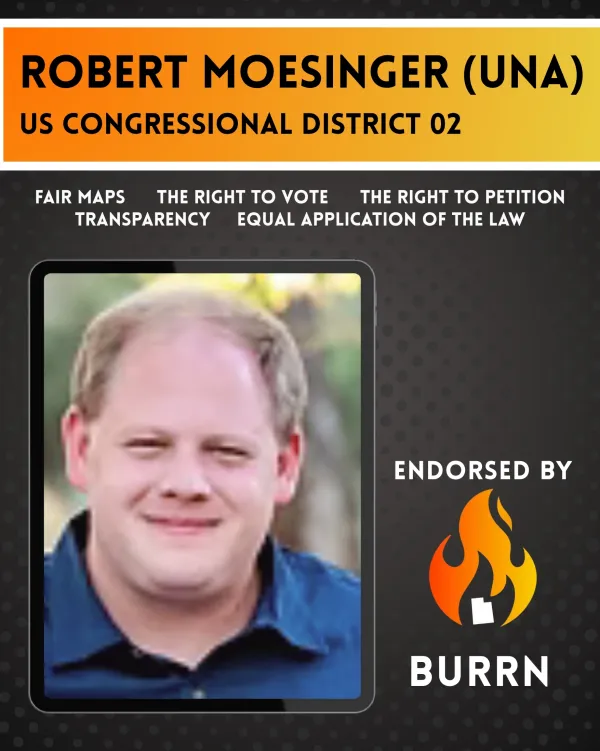
- Do you support or oppose the Independent Redistricting Commission and Standards Act that Utah voters approved in 2018? Please explain your reasoning.
- I support the Independent Redistricting Commission and the principle behind Proposition 4: voters should choose their representatives rather than allowing representatives to choose their voters. An independent process and clear standards against partisan gerrymandering are improvements over asking whichever party controls the Legislature to exercise perpetual self-restraint. However, I think the controversy reveals a deeper problem. In single-member, winner-take-all districts, moving a boundary by a few miles can determine which party is likely to hold a congressional seat for the next decade. As long as district lines have that much political power, every redistricting cycle will create enormous incentives to manipulate them. We can improve the map-drawing process, but we have not removed the underlying incentive.
- This is one outstanding reason why I support ranked-choice voting in multi-member congressional districts. Instead of each district producing one winner and everyone else receiving no representation, several representatives would be elected roughly in proportion to voter support. That makes district boundaries much less capable of predetermining partisan outcomes.
- In summary, I support independent redistricting, but I see it as an important safeguard within a system that still needs deeper reform. Fair maps are good; an electoral system in which the exact placement of the lines matters far less would be better.
- What should happen when the legislature disagrees with a map the commission produces, and what would you do in that situation?
- The Utah Constitution gives the Legislature responsibility for drawing congressional districts, and I think that responsibility should be respected. Proposition 4 did not take that authority away: the independent commission recommends maps, while the Legislature retains the final decision. If legislators disagree with a commission map, they should be able to reject it—but they should publicly explain why and demonstrate that their alternative satisfies the same neutral standards.
- The difficulty is that legislators are not neutral participants in redistricting. Whichever party controls the Legislature has an obvious incentive to draw districts favorable to itself. That is not primarily an accusation of bad character; it is a problem of institutional design. We should not build a system that depends on politicians perpetually exercising restraint against their own electoral interests.
- The Legislature’s weakening of the voter-approved reforms prompted Utah’s courts to reconcile the Legislature’s constitutional redistricting authority with the people’s constitutional initiative and reform rights. Courts should not normally be drawing political maps, but they do have a responsibility to enforce constitutional limits when the political branches exceed them. Mediating between the legislature and its constituents in this way is an uncomfortable situation for the courts, but not necessarily unconstitutional.
- As a member of Congress, I would not control Utah’s map-drawing process. My solution would be upstream: enact ranked-choice voting in multi-member congressional districts. If representation becomes substantially more proportional, moving a boundary no longer has the same power to predetermine which party wins a seat. Rather than continually asking legislators, commissions, and courts to resist powerful partisan incentives, I want an electoral system in which those incentives matter much less.
- Do you support Utah's vote-by-mail system as it stands?
- Utah's vote-by-mail system functions extremely well. There is no evidence of widespread mail-ballot fraud in Utah, and the system includes important safeguards such as signature verification, ballot tracking, and post-election audits. Mailing ballots automatically to active voters also honors our commitment to a democracy in which participation is encouraged and accessible.
- I support preserving in-person voting for Utahns who prefer it, but I see no compelling reason to abandon or substantially restructure our current vote-by-mail system.
- What would you do to encourage more people to vote who currently don't vote?
- The best way to encourage more people to vote is to give them a better reason to believe their vote matters.
- We should continue making voting convenient and accessible, but participation is not only a logistical problem. Many Americans are disengaged because they dislike politics or believe their vote will make little difference. Telling people that voting is a civic duty is worthwhile, but it is less compelling than giving them an electoral system in which their participation can actually change their representation.
- In many winner-take-all districts with a supermajority party, large groups of voters can feel like the result is predetermined and have little incentive to cast a ballot. I support ranked-choice voting in multi-member congressional districts so representation can more closely reflect the voters who actually live there. Under proportional representation, additional votes can help a party or political coalition gain another seat even when it cannot win a majority of the district.
- Research on proportional electoral systems suggests that this can broaden incentives for parties to campaign and mobilize voters throughout a district rather than concentrating only on the relatively small number of competitive races.
- My goal is not simply to ask more people to participate in the existing system. It is to build a system in which more people have a meaningful reason to participate.
- Utah voters can put questions on the ballot through citizen initiatives and referenda. Should the threshold for passing them be changed? Why or why not?
- I would be cautious about raising the threshold for voter initiatives. Utah already requires initiative sponsors to demonstrate broad statewide and geographic support before a proposal reaches the ballot. Once it does, I think a majority vote should ordinarily be enough to pass it, unless there is a compelling reason to depart from that standard.
- There are legitimate concerns about direct democracy: ballot initiatives do not go through the same committee, amendment, and negotiation process as legislation. But initiatives also serve as an important constitutional check when citizens believe their representatives are not addressing an issue. Requiring voters to meet a higher standard than the Legislature itself can create an imbalance between those two sources of legislative power.
- I would therefore evaluate any proposed supermajority requirement very carefully and ask whether it protects the quality of lawmaking or simply makes it harder for citizens to exercise the legislative authority Utah’s Constitution reserves to them.
- What do you see as the relationship between transparency and corruption?
- Transparency decreases corruption, as long as citizens are engaged enough to look for it and abhor it enough to act on what they find. Although those sound like trivial caveats, I think there are serious flaws in the two-party "teams" that we belong to. If your team controls your local government, you may have substantial trust in their virtue—and if the other team claims the found corruption, aren't they always trying to blow these sorts of things out of proportion? Similarly, if you notice a little bit of corruption in your own party, it's certainly much less than what you see on the opposite team. Giving up that seat to the other team is surely much worse than tolerating a bit of misbehavior from your own team.
- In these thought experiments, I think two teams make impartial judgments about misconduct especially difficult. A multiparty democracy, like the one I hope the electoral reforms discussed earlier would encourage, would give voters more alternatives. Discovering corruption in one party would not necessarily require handing power to the one opposing party; citizens could have other places to go. Transparency gives us the information we need to expose corruption, but political competition has to give us meaningful ways to act on it.
- Does Utah's GRAMA support the public's right to know, or does it need strengthening? Or is it too stringent?
- I think GRAMA largely gets the balance right. Government actions should be presumed transparent to the people they serve unless there is a compelling reason for confidentiality. At the same time, the public's right to know should not allow someone to impose an unreasonable administrative burden through repetitive or excessively broad requests, and genuinely private information should remain protected.
- I do have concerns about recent changes to GRAMA's enforcement. I would prefer an appeals process with multiple perspectives rather than placing so much authority in a single decision-maker. I also think ordinary citizens need a realistic way to challenge an improper denial without assuming enormous legal costs, while taxpayers should not necessarily subsidize litigation brought primarily for commercial purposes.
- Overall, I would strengthen GRAMA's mechanisms for fair and independent enforcement rather than substantially changing its basic presumption in favor of public access.
- Describe a specific action you would take in office to make sure every person in your district has equal access to government services and equal protection under the law, regardless of citizenship status.
- I would establish a rotating mobile constituent-services program throughout the district so that people have routine, easy access to my congressional office. My staff would hold regular office hours at libraries, city halls, senior centers, and other accessible public locations, while also maintaining phone, online, and language-assistance options for people who cannot attend in person. We would work with trusted local organizations to make residents aware of the services our office can provide and track where requests are coming from so that we can identify communities we are failing to reach.
- Anyone who lives in the district could ask my office for help navigating the federal government, regardless of citizenship status. Equal access does not mean that every person is legally eligible for every government program, nor could my office promise anyone a particular outcome. It means that no one should be denied our help understanding the law, communicating with a federal agency, or receiving the process and protections to which the law entitles them simply because of who they are or where they were born.
- This kind of outreach also fits directly with my legislative priorities. Meaningful electoral reform will require broad grassroots participation and representatives who are attentive to voices outside their usual partisan constituencies. I therefore have a practical reason, as well as an obligation, to maintain unusually strong communication with people throughout the district and to make it easy for them to participate in their government.
- I want constituents to participate actively in their government, and that requires government to make itself accessible to them. My staff would therefore be expected not merely to wait for people to find us, but to continually look for people and communities we are not yet serving.
- Is there anything else you think is relevant that our questions did not reach?
- These questions have pointed to the exact problems that distressed me enough to decide to run for office. As many Americans feel increasingly poorly represented by our two major parties, we risk allowing our politics to be driven by ideological positions that much of the country does not share. Coupled with increasing polarization, difficulty addressing major long-term problems, and an expanding federal debt, our current direction can feel distressing indeed.
- I believe proportional representation is a robust step toward addressing some of these systemic problems. By giving Americans more meaningful political choices, it can encourage broader participation and healthier competition while responding to the Founders' warnings about the dangers of faction. I believe reforming the structure of our elections can help create a government that represents Americans more faithfully and leaves a stronger country to the next generation.