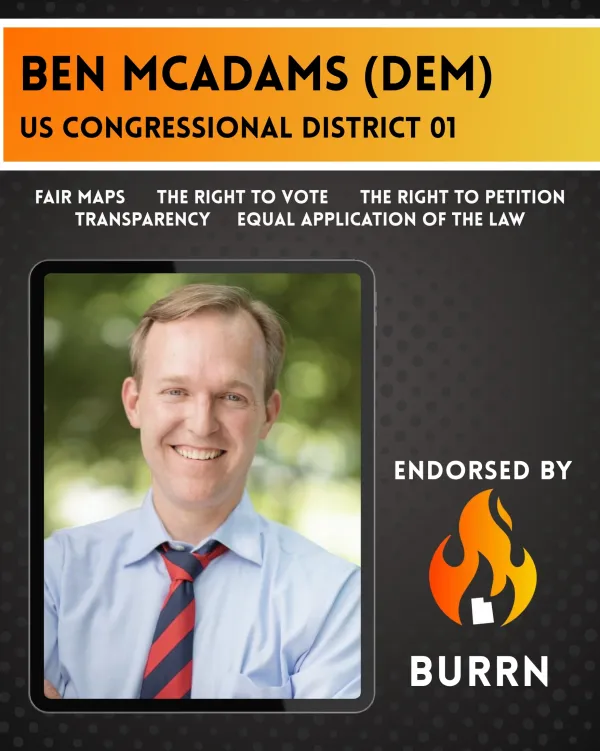
- Do you support or oppose the Independent Redistricting Commission and Standards Act that Utah voters approved in 2018? Please explain your reasoning.
- I strongly support it. Politicians shouldn’t get to pick their own voters, and Utahns said so in 2018. The legislature then spent years working around that vote. In 2020, it replaced Prop 4 with SB 200, which turned the commission into an advisory panel lawmakers could ignore. In 2021, they did exactly that, passing a congressional map that split Salt Lake County four ways so no community here had a real say in who represented it. In 2024, the Utah Supreme Court ruled unanimously that lawmakers can’t simply override a reform the voters passed, and last year a judge threw out the 2021 map. The district I’m running in exists because Utahns refused to let it go.
- Fair maps come before every other issue on this questionnaire. When people know the lines were drawn to make their vote count less, a lot of them stop voting, and who can blame them? That’s the outcome a gerrymander is built to produce. In Congress, I voted for the For the People Act, which would have required independent commissions to draw congressional maps in every state. I’d vote for it again, and I’d add a ban on partisan mid-decade redistricting by legislatures. Both parties have used that tactic this cycle, and voters lose every time they do.
- What should happen when the legislature disagrees with a map the commission produces, and what would you do in that situation?
- Prop 4 already answers this. The legislature can reject the commission’s map, but any map it adopts has to meet the same standards: keep communities and cities together, and don’t draw lines to help or hurt a party or a politician. Lawmakers also have to explain in public, in writing, why their map meets those standards better than the commission’s. If they can’t, voters can take it to court, and the courts should enforce the law the people passed.
- I won’t have a vote on Utah’s map in Congress, and that’s how it should be. I will have a platform, and I’ll use it. I served in the Utah Senate, and I know what it looks like when leadership has decided the outcome before the public sees the bill. If the legislature tosses out a commission map without a real reason, I’ll say so plainly and stand with the Utahns who challenge it. And I’ll keep pushing for federal redistricting standards so that whether your vote counts doesn’t depend on which state you live in.
- Do you support Utah's vote-by-mail system as it stands?
- I support the system Utah built, where every registered voter gets a ballot in the mail. Utah began piloting all-mail elections in 2012 while I was Salt Lake County Mayor, and today it’s how the vast majority of Utahns vote. Lt. Gov. Deidre Henderson has defended its security again and again. She credits it with moving Utah from one of the lowest-turnout states in the country to one of the highest.
- I don’t support HB 300, the 2025 law that ends automatic mail ballots in 2029. Under it, voters have to opt in to keep receiving a ballot, renew it every eight years, and can lose it by missing a regular election. Ballots this year already ask for the last four digits of a driver's license or Social Security number. We should not be taking ballots away from people who are eligible to have them. The people who fall off an opt-in list won’t be fraudsters. They’ll be shift workers, seniors, students, people who moved, or missionaries who missed an election.
- There’s a federal fight too, and that’s where my vote will count. The Trump administration has tried to restrict mail voting by executive order and through a new Postal Service rule, and Sen. Mike Lee has said mail voting shouldn’t survive much longer. The SAVE America Act would require documentary proof of citizenship to register, which hits married women whose birth certificates may not match their current names especially hard. I’ll vote against all of it. Our priority should be making sure every eligible voter can vote easily and securely.
- What would you do to encourage more people to vote who currently don't vote?
- Give them a reason and get the obstacles out of the way.
- The reason matters more than people admit. For a decade, the old map told hundreds of thousands of Salt Lake County voters that their congressional vote was already decided somewhere in Utah County or St. George. Many believed it. A district where your vote actually decides the outcome is the best turnout program there is, which is why protecting Prop 4 is a voting-access issue.
- On the obstacles, I’ll support federal laws for automatic voter registration, same-day registration, prepaid return postage on mail ballots, ballots and voting information in the languages people in this district speak, and steady federal funding for county clerks so they aren’t running elections on whatever’s left over. And I’ll keep doing what this campaign has done: showing up in the neighborhoods that campaigns usually skip because they’ve been written off as “low-turnout.”
- Utah voters can put questions on the ballot through citizen initiatives and referenda. Should the threshold for passing them be changed? Why or why not?
- No. A simple majority is the right standard. Legislators win their seats by majority vote and raise taxes by majority vote. Requiring voters to clear 60 percent tells Utahns their lawmakers trust themselves more than the people who elect them. That’s what Amendment B on this year’s ballot would do to any initiative that creates or raises a tax. Medicaid expansion passed with 53 percent in 2018 and paid for itself with a sales tax increase. Under Amendment B, it would have failed, and many Utahns would not have health care coverage today.
- Utah already has one of the hardest initiative processes in the country. When citizens do clear that bar and win, the legislature has a habit of rewriting the result, which it did to every initiative voters passed in 2018. The process doesn’t need a higher bar. It needs lawmakers who respect the outcome. I’m voting no on Amendment B.
- What do you see as the relationship between transparency and corruption?
- Corruption depends on nobody looking. Nearly every abuse of power I’ve seen in public life comes down to someone making a decision that benefits them or their friends and counting on the public not finding out until it’s too late to reverse.
- In 2011, as a state senator, I voted against HB 477. It went through the legislature in about three days and would have shielded lawmakers’ texts and other messages from public records law. Utahns from every party showed up at the Capitol and forced a repeal within weeks.
- The same principle applies in Congress. Members shouldn’t be trading individual stocks while writing the rules for the companies they own. I’ve called for a ban, and I’ll sign on to the bill that does it.
- Does Utah's GRAMA support the public's right to know, or does it need strengthening? Or is it too stringent?
- It needs strengthening, and the legislature has recently moved it in the wrong direction. In 2025, lawmakers abolished the seven-member citizen State Records Committee and replaced it with a single director appointed by the governor. They also made it far harder for someone who wins a records case in court to recover their attorney fees. The appeals backlog was a problem, but the fix for slow appeals is more staff, not concentrating the decision in one appointee.
- The fee change may be worse. If the government wrongly hides a record, you now pay out of your own pocket to prove it. Most people can’t, so the records stay hidden. The state should restore fee recovery, return appeals to a body no single person controls, and make clear that messages about public business are public records no matter which phone or account they’re on.
- Describe a specific action you would take in office to make sure every person in your district has equal access to government services and equal protection under the law, regardless of citizenship status.
- My district office will help anyone in this district who’s stuck with a federal agency, and we won’t ask about immigration status before we pick up the phone. My office will have caseworkers who speak Spanish and the other languages common in this district. A congressional office is often the only place a family can turn when a case is lost, a check never arrives, or a relative is detained and nobody will say where. As Salt Lake County mayor, I built the Office for New Americans on that same idea: language access, job training, and a real path to citizenship for those eligible.
- That said, not every federal program is open to every person. Constitutional rights are another matter. Due process, a hearing, and protection from unreasonable search and seizure belong to every person in this country regardless of immigration status.
- Right now, more than 125,000 DACA renewal applications are waiting at USCIS, the most ever. Unlike many work permits, DACA work authorization doesn’t get an automatic extension while a renewal is pending, so people who filed on time are losing their jobs while they wait. Any Dreamer in this district with a stalled renewal can call my office, and I’ll do everything in my power to demand the DACA renewal is processed as is already required by the law. I’ll also use oversight to make USCIS explain why it cut processing from several thousand renewals a week to a backlog that has more than quadrupled between the fall of 2025 and the summer of 2026.
- I’ll use a member of Congress’s legal right to make unannounced oversight visits wherever ICE holds people in Utah. No one is above the law, and no one is beneath it.
- Is there anything else you think is relevant that our questions did not reach?
- The fight over Prop 4 isn’t finished. The repeal initiative failed to qualify this year, and legislative leaders have shelved a constitutional amendment for now, but they’ve said they’ll keep pressing in court. Whatever form the next attempt takes, I’ll speak out against it. Voters set the rules for how maps get drawn, and politicians don’t get to undo that because they dislike the result. Utah’s 1st District is what happens when voters keep pushing.