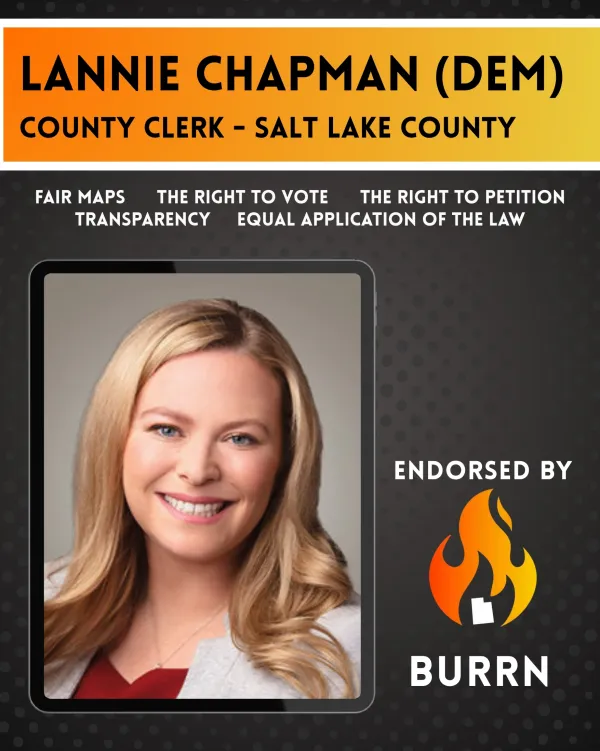
- Do you support or oppose the Independent Redistricting Commission and Standards Act that Utah voters approved in 2018? Please explain your reasoning.
- I support it. Voters passed Proposition 4 to take some of the self-interest out of drawing district lines, and that was a reasonable thing to ask for. My office is the one that takes whatever map is adopted and turns it into precincts, ballot styles, and mailing lists for more than 600,000 voters in Salt Lake County. I’ve seen up close how much district lines shape who gets on a voter’s ballot and whether a race is competitive at all. A commission that operates publicly and follows neutral standards gives people a reason to trust the result, even when they don’t like it.
- What should happen when the legislature disagrees with a map the commission produces, and what would you do in that situation?
- The legislature should say why, in writing and in public, and any map it adopts instead should meet the same standards the commission’s maps had to meet. That’s what voters asked for. Disagreement is fine. It should always be the questions of how this impacts voters, disrupts current maps, and maintains transparency. It should never be about creating maps that strategically advantage one party over the other.
- As Clerk, I implement whatever map is legally in effect, accurately and on time, and make sure voters know which district they live in before their ballot arrives. I’ve done that while maps were tied up in court, and the answer is the same every time: follow the law and the courts, and keep voters informed.
- Do you support Utah's vote-by-mail system as it stands?
- I support vote-by-mail and am proud to be the Clerk of Salt Lake County, as we have one of the most secure systems in the country. Our system works. It has high turnout and strong security checks, and voters across parties like it. The changes passed in 2025 will move Utah to an opt-in system, and starting in 2029, a voter who hasn’t opted in won’t get a ballot in their mailbox automatically. Ballots now also have to reach us by 8 pm on Election Day, regardless of the postmark. I expect some eligible voters to fall through the cracks, especially people who move often, older voters, and voters with disabilities. My office will follow the law, and in the meantime we will spend the next few years making sure every voter in Salt Lake County knows how requirements are shifting so that they have the information and resources to keep voting by mail.
- What would you do to encourage more people to vote who currently don't vote?
- Most people who don’t vote aren’t against voting. They moved, and their registration didn’t follow them, or they don’t know where to drop a ballot, or they think the process is more complicated than it is. That’s a fixable problem. What we can do is meet folks at community events, high schools, etc., to register voters and update addresses on the spot. I’d put more effort into reaching voters in the languages they speak at home and increasing ballot drop box locations in rural areas. Over the next few years, the biggest job will be getting people opted in before the vote-by-mail change takes effect, so nobody shows up to their mailbox in 2029 expecting a ballot that isn’t coming.
- Utah voters can put questions on the ballot through citizen initiatives and referenda. Should the threshold for passing them be changed? Why or why not?
- No. Getting a measure on the ballot in Utah is already hard. In 2025, my office verified hundreds of thousands of signatures for the HB267 Referendum, and I can tell you it takes a serious, organized effort to qualify. That’s where the high bar belongs: at the front end. Once a measure clears it and voters weigh in, a majority should decide it, the same as it does for candidates. Requiring a supermajority for citizen measures, while legislators pass laws by simple majority, sets a different standard for voters than for the people they elect.
- What do you see as the relationship between transparency and corruption?
- Corruption needs room to hide, and transparency takes that room away. In elections, I’ve found the best answer to suspicion is showing people the work: letting observers watch ballot processing, publishing results and audit findings, and explaining how we got to the final count. When people can see a process for themselves, they don’t have to take an official’s word for it. I enjoy giving tours at the Clerk’s office and find that opening up our voting system process creates trust. The same goes for every part of government. Officials who are doing their jobs honestly shouldn’t be afraid of being watched while they do them.
- Does Utah's GRAMA support the public's right to know, or does it need strengthening? Or is it too stringent?
- GRAMA is a good law, and I’d be wary of efforts to narrow it. My office receives a lot of records requests, particularly about elections, and some of them are enormous. The answer to that is giving offices the staff to respond and posting more information online before anyone has to ask for it, not making records harder to get. I’d rather spend our time publishing election data in a form people can use than fighting over what to release.
- Describe a specific action you would take in office to make sure every person in your district has equal access to government services and equal protection under the law, regardless of citizenship status.
- Voting is limited to citizens, but most of what the Clerk’s Office does is not. Anyone who qualifies can get a marriage license in Salt Lake County, and nobody should leave our counter confused or afraid because of a language barrier. In my next term, I want to expand interpretation and translated materials at our marriage license and passport counters, the way we have for election materials. People should be treated the same way at our counter whether they’re a fourth-generation Utahn or only recently moved to our state.
- Is there anything else you think is relevant that our questions did not reach?
- The importance of the Clerk’s office is in running things fairly and efficiently. We want elections people can trust, so we have to ensure that the people who run them keep partisan politics out, because the office exists to serve everyone. That’s how I see the role of County Clerk. I appreciate the opportunity to share my perspective and look forward to continuing to serve Salt Lake County.